
is the interpretation in the Auth. Vers. of the word

The ancient interpreters understand by it a color given to leather, e.g. Sept.
mentions sandals made of the thick skin of a fish which is caught in the Red Sea. It is a species of halicore, named by Ehrenberg (Symb. Phys. 2) Halicora Hemprichii. The skin is clumsy and coarse, and might answer very well for the external covering of the Tabernacle. According to Ehrenberg, the Arabs on the coast call this animal Naka and Lottum. Arabian naturalists applied the term ensan alma, “‘man of the sea,” to this creature. Thevenot speaks of a kind of sea-man, which is taken near the port of Tor. “It is a great strong fish, and hath two hands, which are like the hands of a man, saving that the fingers are joined together with a skin, like the foot of a goose; but the skin of the fish is like the skin of a wild goat or chamois. When they spy that fish, they strike him on the back with harping irons, as they do whales, and so kill him. They use the skin of it for making bucklers, which are musket-proof.” Niebuhr adds the information that “a merchant of Abushahr called dahash that fish which the captains of English ships call porpoise.” The same traveler reports that he saw prodigious schools of these animals swimming. Professor Ruppell (Mus. Senck. 1:113, t. 6), who saw the creature on the coral banks of the Abyssinian coast, ascertained by personal examination that the creature in question was a sort of dugong, a genus of marine Pachydermata, to which he gave the name of Halicore tabernaculi, from a conviction that it was the tachash of Moses. It grows to eighteen feet in length. See WHALE.
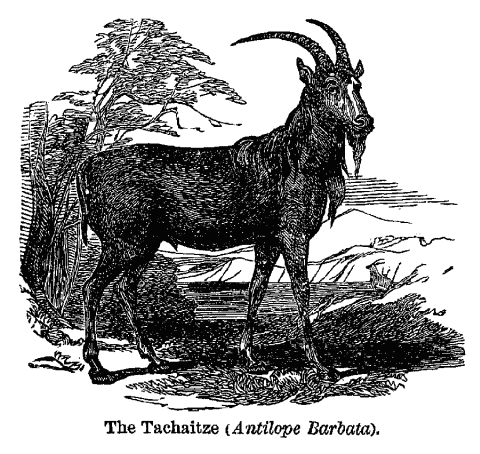
“In the present state of zoological knowledge, however, it is not necessary to refute the notions that tachash was the name of a mermaid or homo- marinus, or of the walrus, a Polar animal, or of the dugong or seal, for neither of these is known in the Indian, Red, or Persian Seas, and there is little probability that in remote ages they frequented the south-east extremity of the Mediterranean, where the current sweeps all things northward; still less that they nestled in the lakes of the Delta, where crocodiles then abounded. But Niebuhr’s hint respecting the name tachash, given, with some reference to colors, to a species of delphinus or porpoise, by the Arabs near Cape Mussendum, may deserve consideration, since the same people still make small rounded bucklers and soles of sandals of the hout’s skin, which is a cetaceous animal, perhaps identical with Niebuhr’s. This material might have been obtained from the caravan-traders of Yemen, or from the Ismaelites of Edom, but does not appear to have been fitted for other purposes than pack-saddles and sandal-soles. Considering tachash, therefore, not to indicate a color, but the skin of an animal, which may have derived its name from its color, probably deep gray, ash, or slaty (hysginus), we must look for the object in question to the zoology of the region around, or to places accessible by means of the traders and tribute importations of raw materials in Egypt, where we actually observe leopard or panther skins, and others of a smaller animal with a long fox-tail, represented in the triumphal procession of Thothmes III at Thebes (Wilkinson’s Anc. Egyptians, 1, pl. 4). These may have been of a canine genus, such as the agriodus, or megalotis Lalandii, which is actually iron- gray; or of a viverrous species, of which there are many in Africa both gray and spotted. Still these are unclean animals, and for this reason we turn to another view of the case, which may prove the most satisfactory that can now be obtained. Negroland and Central and Eastern Africa contain a number of ruminating animals of the great antelope family; they are known to the natives under various names, such as pacasse, empacasse, thacasse, facasse, and tachaitze, all more or less varieties of the word tachash; they are of considerable size, often of slaty and purple-gray colors, and might be termed stag-goats and ox-goats. Of these one or more occur in the hunting-scenes on Egyptian monuments, and therefore we may conclude that the skins were accessible in abundance, and may have been dressed with the hair on for coverings of baggage, and for boots, such as we see worn by the human figures in the same processions. Thus we have the greater number of the conditions of the question sufficiently realized to enable us to draw the inference that tachash refers to a ruminant of the Aigocerine or Damaline groups, most likely of an iron-gray or slaty- colored species” SEE ANTELOPE.