
(
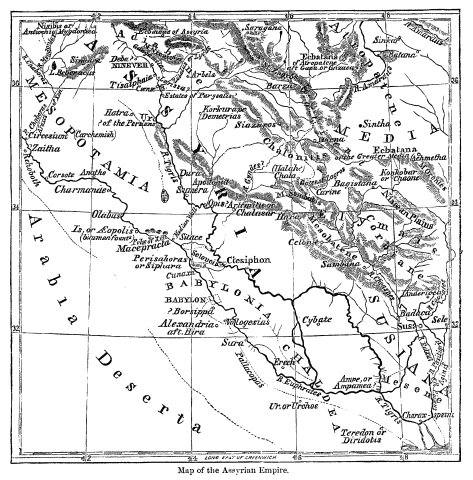
Toward the north Assyria bordered on the strong and mountainous region of Armenia, which may have been at times under Assyrian dominion, but was never reckoned an actual part of the country. (See 2 Kings 19:37.) Toward the east her neighbors were originally a multitude of independent tribes, scattered along the Zagros chain, who have their fitting representatives in the modern Kurds and Lurs-the real sovereigns of that mountain range. Beyond these tribes lay Media, which ultimately subjected the mountaiieers, and was thereby brought into direct contactwith Assyria in this quarter. On the south, Elam or Susiana was the border state east of the Tigris, while Babylonia occupied the same position between the rivers. West of the Euphrates was Arabia, and higher up Syria, and the country of the Ilittites, which last reached from the neighborhood of Damascus to Antitaurus and Amanus.-Smith.
On the north and east the high mountain chains of Armenia and Kurdistan are succeeded by low ranges of limestone hills of a somewhat arid aspect, which detach themselves from the principal ridges, running parallel to them, and occasionally inclosing, between their northern or north-eastern flank and the main mountain-line, rich plains and fertile valleys. To these ridges there succeeds at first an undulating zone of country, well watered and fairly productive, which finally sinks down with some suddenness upon the great Mesopotamian plain, the modern district of ElJezireh. This vast flat, which extends in length for 250 miles from the latitude of Mardin (370 20’) to that of Tekrit (34° 33’), and which is in places of nearly equal width, is interrupted only by a single limestone range, a narrow ridge rising abruptly out of the plain, which, splitting off from Zagros in lat. 33° 30’, may be traced under the names of Sarazur, Hamrin, and Sinjar, from Iwan in Luristan nearly to Rakkah on the Euphrates. " From all parts of the plain the Sinjar is a beautiful object. Its limestone rooks, wooded here and there with dwarf oak, are of a rich golden color; and the numberless ravines which furrow its sides form ribs of deep purple shadow" (Layard, Nineveh and Babylon, p. 265). Above and below this barrier, stretching southward and westward farther than the eye can reach, and extending northward and eastward 70 or 80 miles to the hill-country before mentioned, is an immense level tract, now for the most part a wilderness, scantily watered on the right bank of the Tigris, but abundantly supplied on the left, which bears marks of having been in early times throughout well cultivated and thickly peopled. This plain is not alluvial, and most parts of it are even considerably raised above the level of the rivers. It is covered in spring time with the richest vegetation, presenting to the eye a carpet of flowers, varying in hue from day to day; but as the summer advances it is parched up, and gradually changes to an arid and yellow waste, except along the courses of the rivers. All over this vast flat, on both sides of the Tigris, rise "grass-covered heaps, marking the site of ancient habitations" (Layard, p. 245). Mr. Layard counted from one spot nearly a hundred (Nineveh and its Remains, i7 315); from another above 200 of these lofty mounds (Nin. and Bab. p. 245). Those which have been examined have been uniformly found to present appearances distinctly connecting them with the remains of Nineveh. SEE NINEVEH. It may therefore be regarded as certain that they belong to the time of Assyrian greatness, and thus they will serve to mark the extent of the real Assyrian dominion. They are numerous on the left bank of the Tigris from Bavian to the Diyaleh, and on the right they thickly stud the entire country both north and south of the Sinjar range, extending eastward beyond the Khabour (Layard, chs. xii-xiv), northward to Mardin, and southward to the vicinity of Bagdad.-Smith.
Besides the productions above enumerated, Kurdistan yields gall-nuts, gum Arabic, mastich, manna (used as sugar), madder, castor-oil, and various kinds of grain, pulse, and fruit. An old traveller, Rauwolf, who passed by Mosul in 1574, dwells with admiration on the finely-cultivated fields on the Tigris, so fruitful in corn, wine, and honey as to remind him of the Assyrian Rabshakeh’s description of his native country in 2 Kings 18:32. Rich informs us that a great quantity of honey, of the finest quality, is produced; the bees (comp. Isaiah 7:18, "the bee in the land of Assyria") are kept in hives of mud. The naphtha springs on the east of the Tigris are less productive than those in Mesopotamia, but they are much more numerous. The zoology of the mountain district includes bears (black and brown), panthers, lynxes, wolves, foxes, marmots, dormice, fallow and red deer, roebucks, antelopes, etc., and likewise goats, but not (as was once supposed) of the Angora breed. In the plains are found lions, tigers, hyenas, beavers, jerboas, wild boars, camels, etc.-Kitto.
The chief cities of Assyria in the time of its greatness appear to be the following: Nineveh, which is marked by the mounds opposite Mosul (Nebbi-Yunus and Kouyunjik); Calah or Halah, now Nimrud; Asshur, now Kaleh Sherghat; Sargina, or Dur-Sargina, now Khorsabad; Arbela, still Arbil; Opis, at the junction of the Diyaleh with the Tigris; and Sittace, a little farther down the latter river, if this place should not rather be reckoned to Babylonia. (See the Journal of the Geograph. Soc. vol. 9:part i, p. 35, Lond. 1830.) The capital of the whole country was Nineveh, the Ninos of the Greeks (Herodot. i, 102), the Hebrew name being supposed to denote "the abode of Ninus," the founder of the empire. Its site is believed to have been on the east bank of the Tigris, opposite the modern town of Mosul, where there is now a small town called Nebbi Yunus (i.e. the prophet Jonah), the ruins around which were explored by Rich, and are described in his work on Kurdistan. SEE NINEVEH. In Genesis 10:11, 12, three other cities are mentioned along with Nineveh, viz. Rechoboth Ir, i.e. the city of Rehoboth, the locality of which is unknown. Calach (in our version Calah), either a place in the province of Calachene above mentioned, or the modern Hulwan, called by the Syrians Chalach; and Resen, " a great city between Nineveh and Calach," which Bochart identifies with the Larissa of Xenophon (Anabasis, iii, 47), and Michaelis with a place called Ressin (Rish-Ain, caput fontis?), destroyed by the Arabs A.D. 772. Rich notices an old place and convent of that name near Mosul (ii, 81). At the town of Al-Kosh, north of Mosul, tradition places the birth and burial of the prophet Nahum, and the Jews resort thither in pilgrimage to his tomb. But, though he is styled an Elkoshite (Nahum 1:1), his denunciation against Assyria and Nineveh were evidently uttered in Palestine; and St. Jerome fixes his birthplace at Helkesei, a village in Galilee.-Kitto; Smith. SEE JONAH.
The Christian population is scattered over the whole region, but is found chiefly in the north. It includes Chaldaeans, who form that branch of the Nestorians that adheres to the Church of Rome, a few Jacobites, or monophysite Syrians, Armenians, etc. But the most interesting portion is the ancient Church of the primitive Nestorians, a lively interest in which has lately been excited in the religious world by the publications of the American missionaries (see, especially, The Nestorians, by Asahel Grant, M.D., Lond. 1841; and compare Dr. E. Robinson, in the Am. Bibl. Repos. Oct. 1841; Jan. 1842; Rev. J. Perkins, ib. Jan. 1843; and Residence in Persia, N. Y. 1843). SEE NESTORIANS. Another peculiar race that is met with in this and the neighboring countries is that of the Yezidecs (q.v.), whom Grant and Ainsworth would likewise connect with the ten tribes; but it seems much more probable that they are an offshoot from the ancient Manichees, their alleged worship of the Evil Principle amounting to no more than a reverence which keeps them from speaking of him with disrespect (see Homes, in the Am. Bibl. Repos. for April, 1842). Besides the dwellers in towns and the agricultural population, there are a vast number of wandering tribes, not only of Kurds, but of Arabs, Turkomans, and other classes of robbers, who, by keeping the settled inhabitants in constant dread of property and life, check every effort at improvement; and, in consequence of this and the influence of bad government, many of the finest portions of the country are little better than unproductive wastes. A copy of a famous history of Kurdistan, entitled Tarikh al-Akrad (Akrad being the collective name of the people), was procured by Mr. Rich when in the country, and is now, along with the other valuable Oriental MSS. of that lamented traveller, preserved in the British Museum. SEE KURDISTAN.
In the time of the Judges, the people of Israel became subject to a king of Mesopotamia, Chushan-rishathaim (Judges 3:8), who is by Josephus styled King of the Assyrians; but we are left in the same ignorance as in the case of Chedorlaomer as to whether he was an independent sovereign or only a vicegerent for another. The eighty-third Psalm (ver. 9) mentions Ashur as one of the nations leagued against Israel; but as the date of that composition is unknown, nothing certain can be founded on it. The first king of Assyria alluded to in the Bible is he who reigned at Nineveh when the prophet Jonah was sent thither (Jonah 3:6). Hales supposes him to have been the father of Pul, the first Assyrian monarch named in Scripture, and dates the commencement of his reign B.C. 821. By that time the metropolis of the empire had become "an exceeding great" and populous city, but one pre-eminent in wickedness (Jonah 1:2; 3:3; 4:11). SEE JONAH.
The first expressly recorded appearance of the Assyrian power in the countries west of the Euphrates is in the reign of Menahem, king of Israel, against whom "the God of Israel stirred up the spirit of Pul or (Phul), king of Assyria" (1 Chronicles 5:26), who invaded the country, and exacted a tribute of a thousand talents of silver "that his hand," i.e. his favor, "might be with him to confirm the kingdom in his hand" (2 Kings 15:19, 20). Newton places this event in the year B.C. 770, in the twentieth year of Pul’s reign, the commencement of which he fixes in the year B.C. 790. As to his name, we find the syllable Pal, Pel, or Pul entering into the names of several Assyrian kings (e.g. Pileser, Sardanapal-us); and hence some connect it with the Persian " balm," i.e. high, exalted, and think it may have been part of the title which the Assyrian monarchs bore. Hales conjectures that Pul may have been the second Belus of the Greeks, his fame having reached them by his excursions into Western Asia. About this period we find the prophet Hosea making frequent allusions to the practice both of Israel and Judsea, of throwing themselves for support on the kings of Assyria. In ch. 5:13; 10:6, our version speaks of their specially seeking the protection of a "King Jareb," but the original there is very obscure; and the next Assyrian monarch mentioned by name is Tiglath-pileser. The supposition of Newton is adopted by Hales, that at Pul’s death his dominions were divided between his two sons, Tiglath-pileser and Nabonassar, the latter being made ruler at Babylon, from the date of whose government or reign the celebrated era of Nabonassar took its rise, corresponding to B.C. 747. The name of the other is variously written Tiglath and Tilgath, Pileser and Pilreser: the etymology of the first is unknown (some think it has a reference to the river Dijlath, i.e. the Tigris). Pileser signifies in Persian "exalted prince." When Ahaz, king of Judah, was hard pressed by the combined forces of Pekah, king of Israel, and Rezin, king of DamasceneSyria, he purchased Tiglath-pileser’s assistance with a large sum, taken out of his own and the Temple treasury. The Assyrian king accordingly invaded territories of both the confederate kings, and annexed a portion of them to his own dominions, carrying captive a number of their subjects (2 Kings 15:29; 16:5-10; 1 Chronicles 5:26; 2 Chronicles 28:16; Isaiah 7:1-11; comp. Amos 1:9:7). His successor was Shalman (Hosea 10:4), Shalmaneser or Salmanassar, the Enemessar of the apocryphal book of Tobit (ch. 1:2). He made Hoshea, king of Israel, his tributary vassal (2 Kings 17:3); but finding him secretly negotiating with So or Sabaco (the Sabakoph of the monuments), king of Egypt, he laid siege to the Israelitish capital, Samaria, took it after an investment of three years (B.C. 720), and then reduced the country of the ten tribes to a province of his empire, carrying into captivity the king and his people, and settling Cutheeans from Babylonia in their room (2 Kings 17:3-6; 18:9, 11). Hezekiah, king of Judah, seems to have been for some time his vassal (2 Kings 18:7); and we learn from the Tyrian annals, preserved by Menatlder of Ephesus (as cited by Josephus, Ant. 10:14, 2), that he subdued the whole of Phoenicia, with the exception of insular Tyre, which successfully resisted a siege of five years. The empire of Assyria seems now to have reached its greatest extent, having had the Mediterranean for its boundary on the west, and including within its limits Media and Kir on the north, as well as Elam on the south (2 Kings 16:9; 17:6; Isaiah 20:6). In the twentieth chapter of Isaiah (ver. 1) there is mention of a king of Assyria, Sargon, in whose reign Tartan besieged and took Ashdod in Philistia (B.C. 715) SEE SARGON; and as Tartan is elsewhere spoken of (2 Kings 18:17) as a general of Sennacherib, some have supposed that Sargon is but another name of that monarch, while others would identify him either with Shalmaneser, or with Esarhaddon, Sennacherib’s successor. But the correctness of all these conjectures may fairly be questioned; and we adhere to the opinion of Gesenius (Comment. zu Jesa. in loc.), that Sargon was a king of Assyria, who succeeded Shalmaneser, and had a short reign of two or three years. He thinks the name may be equivalent to Ser-jaumeh, "Prince of the Sun." Von Bohlen prefers the derivation of sergun, "gold-colored." His attack on Egypt may have arisen from the jealousy which the Assyrians entertained of that nation’s influence over Palestine ever since the negotiation between its king So, and Hoshea, king of Israel. From many incidental expressions in the book of Isaiah we can infer that there was at this time a strong Egyptian party among the Jews, for that people are often warned against relying for help on Egypt, instead of simply confiding in Jehovah (Isaiah 30:2; 31:1; comp. 20:5, 6). The result of Tartan’s expedition against Egypt and Ethiopia was predicted by Isaiah while that general was yet on the Egyptian frontier at Ashdod (Isaiah 20:1-4); and it is not improbable that it is to this Assyrian invasion that the prophet Nahum refers when he speaks (Nahum 3:8-10) of the subjugation of No, i.e. No-Ammun, or Thebes, the capital of Upper Egypt, and the captivity of its inhabitants. The occupation of the country by the Assyrians, however, must have been very transient, for in the reign of Sapgon’s successor, Sennacherib, or Sancherib, we find Hezekiah, king of Judah, throwing off the Assyrian yoke, and allying himself with Egypt (2 Kings 18:7, 21). This brought against him Sennacherib with a mighty host, which, without difficulty, subdued the fenced cities of Judah, and compelled him to purchase peace by the payment of a large tribute. But "the treacherous dealer dealt very treacherously" (Isaiah 33:1), and, notwithstanding the agreement, proceeded to invest Jerusalem. In answer, however, to She prayers of the " good king" of Judah, the Assyrian was diverted from his purpose, partly by the "rumor" (Isaiah 37:6) of the approach of Tirhakah, king of Ethiopia, and partly by the sudden and miraculous destruction of a great p rt of his army (2 Kings 18:13-37; 19; Isaiah 36 and 37). He himself fled (B.C. 712) to Nineveh, where, in course of time, when worshipping in the temple of his god Nisroch, he was slain by his sons Adrammelech and Sharezer, the parricides escaping into the land of Armenia-a fact which is preserved in that country’s traditionary history. SEE ARARAT. Regarding the period of Sennacherib’s death chronologists differ. Hales, following the apocryphal book of Tobit (i, 21), places it fifty-five days after his return from his Jewish expedition; but Gesenius (Comment. zu Jesa. p. 999) has rendered it extremely probable that it did not take place till long after. He founds this opinion chiefly on a curious fragment of Berosus, preserved in the Armenian translation of the Chronicle of Eusebius. It states that, after Sennacherib’s brother had governed Babylon as the Assyrian viceroy, the sovereignty was successively usurped by Acises, Merodach, or BerodachBaladan (Isaiah 39:1; 2 Kings 20:12), and Elibus or Belibus. But, after three years, Sennacherib regained dominion in Babylonia, and appointed as viceroy his own son Assordan, the Esarhaddon of Scripture.’ This statement serves to explain how there was in Hezekiah’s time a king at Babylon, though, both before and after, it was subject to Assyria. SEE SENNACHERIB. Sennacherib was succeeded by- his son Esarhaddon, or Assarhaddon, who had been his father’s viceroy at Babylon (2 Kings 19:37; Isaiah 37:38). He is the Sacherdon or Sarchedon of Tobit (i, 21), and the Asaradinus of Ptolemy’s Canon (B.C. 680). Hales regards him as the first Sardanapalus. The chief notice taken of him in Scripture is that he settled some colonists in Samaria (Ezra 4:2), and as (at ver. 10) that colonization is ascribed to the "great and noble Asnapper," it is supposed that that was another name for Esarhaddon, but it may have been one of the great officers of his empire. It seems to have been in his reign that the captains of the Assyrian host invaded and ravaged Judah, carrying Manasseh, the king, captive to Babylon. The subsequent history of the empire is involved in almost as much obscurity as that of its origin and rise. The Medes had already shaken off the yoke, and the Chaldaeans soon appear on the scene as the dominant nation of Western Asia; yet Assyria, though much reduced in extent, existed as an independent state for a considerable period after Esarhaddon. Hales, following Syncellus, makes him succeeded by a prince called Ninus (B.C. 667), who had for his successor Nebuchodonosor (B.C. 658), for the transactions of whose reign, including the expedition of his general Holofernes into Judesa, Hales relies on the apocryphal book of Judith, the authority of which, however, is very questionable. The last monarch was Sarac, or Sardanapalus II (B.C. 636), in whose reign Cyaxares, king of Media, and Nabopolassar, viceroy of Babylon, combined against Assyria, took Nineveh, and, dividing what remained of the empire between them, reduced Assyria Proper to a province of Media (B.C. 606).
(1.) The original Settlement of the Country. —Scripture informs us that Assyria was peopled from Babylon (Genesis 10:11), and both classical tradition and the monuments of the country agree in this representation. In Herodotus (i, 7), Ninus, the mythic founder of Nineveh, is the son (descendant) of Belus, the mythic founder of Babylon-a tradition in which the derivation of Assyria from Babylon, and the greater antiquity and superior position of the latter in early times, are shadowed forth sufficiently. That Ctesias (ap. Diod. Sic. ii, 7). inverts the relation, making Semiramis (according to him, the wife and successor of Ninus) found Babylon, is only one out of a thousand proofs of the untrustworthy character of his history. The researches recently carried on in the two countries clearly show, not merely by the statements which are said to have been deciphered on the historical monuments, but by the whole character of the remains discovered, that Babylonian greatness and civilization was earlier than Assyrian, and that, while the former was of native growth, the latter was derived from the neighboring country. The cuneiform writing, for instance, which is rapidly punched with a very simple instrument upon moist clay, but is only with much labor and trouble inscribed by the chisel upon rock, must have been invented in a country where men "had brick for stone’ (Genesis 11:3), and have thence passed to one where the material was unsuited for it. It may be observed, also, that while writing occurs in a very rude form in the earlier Babylonian ruins (Loftus’s Chaldaa, p. 169), and gradually improves in the later ones, it is in Assyria uniformly of an advanced type, having apparently been introduced there after it had attained to perfection.
(2.) Date of the Foundation of the Kingdom.-With respect to the exact time at which Assyria became a separate and independent country, there is an important difference between classical authorities, Herodotus placing the commencement of the empire almost a thousand years later than Ctesias! Scripture does but little to determine the controversy; that little, however, is in favor of the former author. Geographically, as a country, Assyria was evidently known to Moses (Genesis 2:14; 25:18; Numbers 24:22, 24); but it does not appear in Jewish history as a kingdom till the reign of Menahem (B.C. cir. 770). In Abraham’s time (B.C. 2000 ?) it is almost certain that there can have been no Assyrian kingdom, or its monarch would have been found among those who invaded Palestine with Chedorlaomer’ (Genesis 14:1). In the time of the early judges (B.C. 1575), Assyria, if it existed, can have been of no great strength; for Chushan-Rishathaim, the first of the foreigners who oppressed Israel (Judges 3:8), is master of the whole country between the rivers (Aram Naharim=" Syria between the two rivers"). These tacts militate strongly against the views of Ctesias, whose numbers produce for the founding of the empire the date of B.C. 2182 (Clinton, Fast. Hell. i, 263). The more modest account of Herodotus is at once more probable in itself, more agreeable to Scripture, and more in accordance with the native writer Berosus. Herodotus relates that the Assyrians were "lords of Asia" for 520 years, when their empire was partially broken up by a revolt of the subject- nations (i, 95). After a period of anarchy, the length of which he does not estimate, the Median kingdom was formed, 179 years before the death of Cyrus, or B.C. 708. He would thus, it appears, have assigned to the foundation of the Assyrian empire a date not very greatly anterior to B.C. 1228. Berosus, who made the empire last 526 years to the reign of Pul (ap. Euseb. Chronicles Arm. i, 4), must have agreed nearly with this view-at least he would certainly have placed the rise of the kingdom within the 13th century. This is, perhaps, the utmost that can be determined with any approach to certainty. If, for convenience’ sake, a more exact date be desired, the conjecture of Dr. Brandis has some claim to be adopted, which fixes the year B.C. 1273 as that from which the 526 years of Berosus are to be reckoned (Rerum Assyriarum Tempora Emendata, p. 17).
(3.) Early Kings, from the foundation of the Kingdom to Pul. — The long list of Assyrian kings which has come down to us in two or three forms, only slightly varied (Clinton, F. H. i, 267), and which is almost certainly derived from Ctesias, must of necessity be discarded, together with his date for the kingdom. It covers a space of above 1200 years, and bears marks besides of audacious fraud, being composed of names snatched from all quarters, Arian, Semitic, and Greek-names of gods, names of towns, names of rivers-and in its estimate of time presenting the impossible average of 34 or 35 years to a reign, and the very improbable phenomenon of reigns in half the instances amounting exactly to a decimal number. Unfortunately, we have no authentic list to substitute for the forgery of Ctesias. Berosus spoke of 45 kings as reigning during his period of 526 years, and mentioned all their names (Euseb. ut sup.); but they have unluckily not been preserved to us. The work of Herodotus on Assyrian history (Herod. i, 106 and 184) has likewise entirely perished, and neither Greek nor Oriental sources are available to supply the loss, which has hitherto proved irreparable. Recently the researches in Mesopotamia have done something toward filling up this sad gap in our knowledge; but the reading of names is still so doubtful that it seems best, in the present condition of cuneiform inquiry, to treat the early period of Assyrian history in a very general way, only mentioning kings by name when, through the satisfactory identification of a cuneiform royal designation with some name known to us from sacred or profane sources, firm ground has been reached, and serious error rendered almost impossible.
The Mesopotamian researches have rendered it apparent that the original seat of government was not at Nineveh. The oldest Assyrian remains have been found at Kaleh-Sherghat, on the right bank of the Tigris, 60 miles south of the later capital; and this place the monuments show to have been the residence of the earliest kings, as well as of the Babylonian governors who previously exercised authority over the country. The ancient name of the town appears to have been identical with that of the country, viz. Asshur. It was built of brick, and has yielded but a very small number of sculptures. The kings proved to have reigned there are fourteen in number, divisible into three groups; and their reigns are thought to have covered a space of nearly 350 years, from B.C. 1273 to B.C. 930. The most remarkable monarch of the series was called Tiglath-Pileser. He appears to have been king toward the close of the twelfth century, and thus to have been contemporary with Samson, and an earlier king than the Tiglath- Pileser of Scripture. He overran the whole country between Assyria Proper and the Euphrates; swept the valley of the Euphrates from south to north, from the borders of Babylon to Mount Taurus; crossed the Euphrates, and contended in northern Syria with the Hittites; invaded Armenia and Cappadocia; and claims to have subduedforty-two countries " from the channel of the Lower Zab (Zab Asfal) to the Upper Sea of the Setting Sun." All this he accomplished in the first five years of his reign. At a later date he appears to have suffered defeat at the hands of the king of Babylon, who had invaded his territory and succeeded in carrying off to Babylon various idols from the Assyrian temples (Offerhaus, De ant. Assyr. imperio, Linga, 1727).
The other monarchs of the Kaleh-Sherghat series, both before and after Tiglath-Pileser, are comparatively insignificant. The later kings of the series are only known to us as the ancestors of the two great monarchs Sardanapalus the first and his son, Shalmaneser or Shalmanubar, who were among the most warlike of the Assyrian princes. Sardanapalus the first, who appears to have been the warlike Sardanapalus of the Greeks (Suidas, s.v.; comp. Hellan. Frag. p. 158), transferred the seat of government from Kaleh-Sherghat to Nimrud (probably the Scriptural Calah), where he built the first of those magnificent palaces which have recently been exhumed by English explorers. A great portion of the Assyrian sculptures now in the British Museum are derived from this edifice. A description of the building has been given by Mr. Layard (Nin. and its Remains, vol. ii, ch. 11). By an inscription repeated more than a hundred times upon its sculptures we learn that Sardanapalus carried his arms far and wide through Western Asia, warring on the one hand in Lower Babylonia and Chaldea, on the other in Syria and upon the coast of the Mediterranean. His son, Shalmaneser or Shalmanubar, the monarch who set up the Black Obelisk, now in the British Museum, to commemorate his victories, was a still greater conqueror. He appears to have overrun Cappadocia, Armenia, Azerbejan, great portions of Media Magna, the Kurdish mountains, Babylonia, Mesopotamia, Syria, and Phoenicia; everywhere making the kings of the countries tributary to him. If we may trust the reading of certain names, on which cuneiform scholars appear to be entirely agreed, he came in contact with various Scriptural personages, being opposed in his Syrian wars by Benhadad and Hazael, kings of Damascus, and taking tribute from Jehu, king of Israel. His son and grandson followed in his steps, but scarcely equalled his glory. The latter is thought to be identical with the Biblical Pul, Phul, or Phaloch, who is the first of the Assyrian kings of whom we have mention in Scripture. SEE PUL.
(4.) The Kings from Pul to Esarhaddon. — The succession of the Assyrian kings from Pul almost to the close of the empire is rendered tolerably certain, not merely by the inscriptions, but also by the Jewish records. In the 2d book of Kings we find the names of Pul, Tiglath-Pileser, Shalmaneser, Sennacherib, and Esarhaddon, following one another in rapid succession (2 Kings 15:19 and 29; 17:3; 18:13; 19:37); and in Isaiah we have the name of " Sargon, king of Assyria" (xx, 1), who is a contemporary of the prophet, and who must evidently, therefore, belong to the same series. The inscriptions, by showing us that Sargon was the father of Sennacherib, fix his place in the list, and give us for the monarchs of the last half of the 8th and the first half of the 7th century B.C. the (probably) complete list of TiglathPileser II, Shalmaneser II, Sargon, Sennacherib, and Esarhaddon. For a detailed account of the actions of these kings, see each name in its place. (See Oppert, Chronologie des Assyriens et des Babylonens, Paris, 1857.)
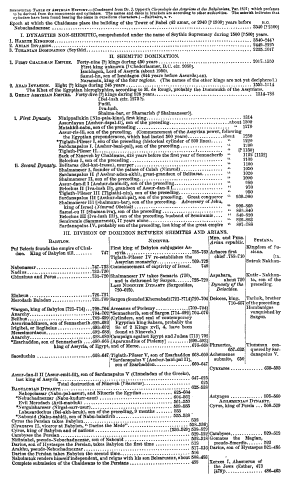
(a.) Establishment of the Lower Dynasty. — It seems to be certain that at or near the accession of Pul a great change of some kind or other occurred in Assyria. Berosus is said to have brought his grand dynasty of forty-five kings in 526 years to a close at the reign of Pul (Polyhist. ap. Euseb. 1. c.), and to have made him the first king of a new series. By the synchronism of Menahem (2 Kings 15:19), the date of Pul may be determined to about B.C. 770. It was only twenty-three years later, as we find by the Canon of Ptolemy, that the Babylonians considered their independence to have commenced (B.C. 747). Herodotus probably intended to assign nearly to this same era the great commotion which (according to him) broke up the Assyrian empire into a number of fragments, out of which were formed the Median and other kingdoms. These traditions may none of them be altogether trustworthy; but their coincidence is at least remarkable, and seems to show that about the middle of the eighth century B.C. there must have been a break in the line of Assyrian kings-a revolution, foreign or domestic and a consequent weakening or dissolution of the bonds which united the conquered nations with their conquerors.
It was related by Bion and Polyhistor (Agathias, ii, 25), that the original dynasty of Assyrian kings ended with a certain Belochus or Beleus, who was succeeded by a usurper (called by them Beletaras or Balatorus), in whose family the crown continued until the destruction of Nineveh. The general character of the circumstances narrated, combined with a certain degree of resemblance in the names-for Belochus is close upon Phaloch, and Beletaras may represent the second element in TigIath-Pileser (who in the inscriptions is called “Tiglath-Palatsira")-induce a suspicion that probably the Pul or Phaloch of Scripture was really the last king of the old monarchy, and that TiglathPileser II, his successor, was the founder of what has been called the "Lower Empire." It maybe suspected that Berosus really gave this account, and that Polyhistor, who repeated it, has been misreported by Eusebius. The synchronism between the revolution in Assyria and the era of Babylonian independence is thus brought almost to exactness, for Tiglath-Pileser is known to have been upon the throne about B.C. 740 (Clinton, Fast. Tell. i, 278), and may well have ascended it in B.C. 747.
(b.) Supposed Loss of the Empire at this Period. Many writers of repute- among them Clinton and Niebuhr-have been inclined to accept the statement of Herodotus with respect to the breaking up of the whole empire at this period. It is evident, however, both from Scripture and from the monuments, that the shock sustained through the domestic revolution has been greatly exaggerated. Niebuhr himself observes (Vortrige uber alte Geschichte, i, 38) that, after the revolution, Assyria soon "recovered herself, and displayed the most extraordinary energy." It is plain, from Scripture, that in the reigns of Tiglath-Pileser, Shalmaneser, Sargon, Sennacherib, and Esarhaddon, Assyria was as great as at any former era.
These kings all warred successfully in Palestine and its neighborhood; some attacked Egypt (Isaiah 20:4); one appears as master of Medil (2 Kings 17:6); while another has authority over Babylon, Susiana, and Elymais (2 Kings 17:24; Ezra 4:9). So far from our observing symptoms of weakness and curtailed dominion, it is clear that at no time were the Assyrian arms pushed farther, or their efforts more sustained and vigorous. The Assyrian annals for the period are in the most complete accordance with these representations. They exhibit to us the above- mentioned monarchs as extending their dominions farther than any of their predecessors. The empire is continually rising under .them, and reaches its culminating point in the reign of Esarhaddon. The statements of the inscriptions on these subjects are fully borne out by the indications of greatness to be traced in the architectural monuments. No palace of the old monarchy equalled, either in size or splendor, that of Sennacherib at Nineveh. No series of kings belonging to it left buildings at all to be compared with those which were erected by Sargon, his son, and his grandson. The magnificent remains at Kouyunjik and Khorsabad belong entirely to these later kings, while those at Nimrud are about equally divided between them and their predecessors. It is farther noticeable that the writers who may be presumed to have drawn from Berosus, as Polyhistor and Abydenus, particularly expatiated upon the glories of these later kings. Polyhistor said (ap. Euseb. i, 5) that Sennacherib conquered Babylon, defeated a Greek army in Cilicia, and built there Tarsus, the capital. Abydenus related the same facts, except that he substituted for the Greek army of Polyhistor a Greek fleet; and added that Esarhaddon (his Axerdis) conquered Lower Syria and Egypt (ibid. i, 9). Similarly Menander, the Tyrian historian, assigned to Shalmaneser an expedition to Cyprus (ap. Joseph. Ant. 9:14), and Herodotus himself admitted that Sennacherib invaded Egypt (ii, 141). On every ground it seems necessary to conclude that the second Assyrian kingdom was really greater and more glorious than the first; that under it the limits of the empire reached their fullest extent, and the internal prosperity was at the highest.
The statement of Herodotus is not, however, without a basis of truth. It is certain that Babylon, about the time of Tiglath-Pileser’s accession, ventured upon a revolt, which she seems afterward to have reckoned the commencement of her independence. SEE BABYLON. The knowledge of this fact may have led Herodotus into his error; for he would naturally suppose that, when Babylon became free, there was a general dissolution of the empire. It has been shown that this is far from the truth; and it may farther be observed that, even as regards Babylon, the Assyrian loss was not permanent. Sargon, Sennacherib, and Esarhaddon all exercised full authority over that country, which appears to have been still an Assyrian fief at the close of the kingdom.
(5.) Successors of Esarhaddon. — By the end of the reign of Esarhaddon the triumph of the Assyrian arms had been so complete that scarcely an enemy was left who could cause her serious anxiety. The kingdoms of Hamath, of Damascus, and of Samaria had been successively absorbed; Phoenicia had been conquered; Judsea had been made a feudatory; Philistia and Idumaea had been subjected, Egypt chastised, Babylon recovered, cities planted in Media. Unless in Armenia and Susiana there was no foe left to reduce, and the consequence appears to have been that a time of profound peace succeeded to the long and bloody wars of Sargon and his immediate successors. In Scripture it is remarkable-that we hear nothing of Assyria after the reign of Esarhaddon, and profane history is equally silent until the attacks begin which brought about her downfall. The monuments show that the son of Esarhaddon, who was called Sardanapalus by Abydenus (ap. Euseb. i, 9), made scarcely any military expeditions, but occupied almost his whole time in the enjoyment of the pleasures of the chase. ’Instead of adorning his residence-as his predecessors had been accustomed to do--with a record and representation of his conquests, Sardanapalus II covered the walls of his palace at Nineveh with sculptures exhibiting his skill and prowess as a hunter. No doubt the military spirit rapidly decayed under such a ruler; and the advent of fresh enemies, synchronizing with this decline, produced the ruin of a power which had for six centuries been dominant in Western Asia.
(6.) Fall of Assyria. — The fate of Assyria, long previously prophesied by Isaiah (Isaiah 10:5-19), was effected (humanly speaking) by the growing strength and boldness of the Medes. If we may trust Herodotus, the first Median attack on Nineveh took place about the year B.C. 633. By what circumstances this people, who had so long been engaged in contests with the Assyrians, and had hitherto shown themselves so utterly unable to resist them, became suddenly strong enough to assume an aggressive attitude, and to force the Ninevites to submit to a siege, can only be conjectured. Whether mere natural increase, or whether fresh immigrations from the east had raised the Median nation at this time so far above its former condition, it is impossible to determine. We can only say that soon after the middle of the seventh century they began to press upon the Assyrians, and that, gradually increasing in strength, they proceeded, about the year B.C. 633, to attempt the conquest of the country. For some time their efforts were unsuccessful; but after a while, having won over the Babylonians to their side, they became superior to the Assyrians in the field, and about B.C. 625, or a little earlier, laid final siege to the capital. SEE MEDIA. Saracus, the last king-probably the grandson of Esarhaddon- made a stout and prolonged defence, but at length, finding resistance vain, he collected his wives and his treasures in his palace, and with his own hand setting fire to the building, perished in the flames. This account is given in brief by Abydenus, who probably follows Berosus; and its outline so far agrees with Ctesias (ap. Diod. ii, 27) as to give an important value to that writer’s details of the siege. SEE NINEVEH. In the general fact that Assyria was overcome, and Nineveh captured and destroyed by a combined attack of Medes and Babylonians, Josephus (Ant. 10:5) and the book of Tobit (xiv, 15) are agreed. Polyhistor also implies it (ap. Euseb. i, 5); and these authorities must be regarded. as outweighing the silence of Herodotus, who mentions only the Medes in connection with the capture (i, 106), and says nothing of the Babylonians.
(7.) Fulfilment of Prophecy.-The prophecies of Nahum and Zephaniah (Zephaniah 2:13-5) against Assyria were probably delivered shortly before the catastrophe. The date of Nahum is very doubtful, but it is not unlikely that he wrote about B.C. 718, or at the close of the reign of Hosea. Zephaniah is even later, since he prophesied under Josiah, who reigned from B.C. 639 to 609. If B.C. 625 be the date of the destruction of Nineveh, we may place Zephaniah’s prophecy about B.C. 635. Ezekiel, writing in B.C. 588, bears witness historically to the complete destruction which had come upon the Assyrians, using the example as a warning to Pharaoh-Hophra and the Egyptians (ch. 31).
It was declared by Nahum (q.v.) emphatically, at the close of his prophecy, that there should be "no healing of Assyria’s bruise" (Nahum 3:19). In accordance with this announcement we find that Assyria never rose again to any importance, nor even succeeded in maintaining a distinct nationality. Once only was revolt attempted, and then in conjunction with Armenia and Media, the latter heading the rebellion. This attempt took place about a century after the Median conquest, during the troubles which followed upon the accession of Darius Hystaspis. It failed signally, and appears never to have been repeated, the Assyrians remaining thenceforth submissive subjects of the Persian empire. They were reckoned in the same satrapy with Babylon (Herod. iii, 92; comp. i, 192), and paid an annual tribute of a thousand talents of silver. In the Persian armies, which were drawn in great part from the subject-nations, they appear never to have been held of much account, though they fought, in common with the other levies, at Thermopyle, at Cunaxa, at Issus, and at Arbela.
(8.) General Character of the Empire. — In the first place, like all the early monarchies which attained to any great extent, the Assyrian empire was composed of a number of separate kingdoms. In the East, conquest has scarcely ever been followed by amalgamation, and in the primitive empires there was not even any attempt at that governmental centralization which we find at a later period in the satrapial system of Persia. As Solomon " reigned over all the kingdoms from the river (Euphrates) unto the land of the Philistines and the border of Egypt," so the Assyrian monarchs bore sway over a number of petty kings--the native rulers of the several countries-through the entire extent of their dominions. These native princes-the sole governors of their own kingdoms--were feudatories of the Great Monarch, of whom they held their crown by the double tenure of homage and tribute. Menahem (2 Kings 15:19), Hoshea (2 Kings 17:4), Ahaz (2 Kings 16:8), Hezekiah (2 Kings 18:14), and Manasseh (2 Chronicles 33:11-13), were certainly in this position, as were many native kings of Babylon, both prior and subsequent to Nabonassar; and this system (if we may trust the inscriptions) was universal throughout the empire. It naturally involved the frequent recurrence of troubles. Princes circumstanced as were the Assyrian feudatories would always be looking for an occasion when they might revolt and re-establish their independence. The offer of a foreign alliance would be a bait which they could scarcely resist, and hence the continual warnings given to the Jews to beware of trusting in Egypt. Apart from this, on the occurrence of any imperial misfortune or difficulty, such, for instance, as a disastrous expedition, a formidable attack, or a sudden death, natural or violent, of the reigning monarch, there would be a strong temptation to throw off the yoke, which would lead, almost of necessity, to a rebellion. The history of the kings of Israel and Judah sufficiently illustrates the tendency in question, which required to be met by checks and remedies of the severest character. The deposition of the rebel prince, the wasting of his country, the plunder of his capital, a considerable increase in the amount of the tribute thenceforth required, were the usual consequences of an unsuccessful revolt; to which were added, upon occasion, still more stringent measures, as the wholesale execution of those chiefly concerned in the attempt, or the transplantation of the rebel nation to a distant locality. The captivity of Israel is only an instance of a practice long previously known to the Assyrians, and by them handed on to the Babylonian and Persian governments.
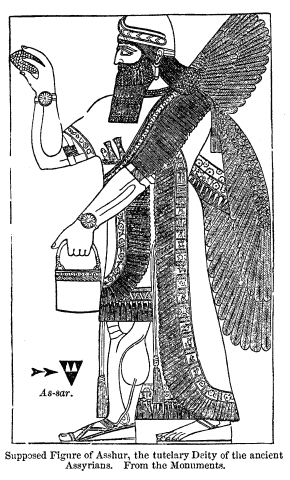
It is not quite certain how far Assyria required a religious conformity from the subject people. Her religion was a gross and complex polytheism, comprising the worship of thirteen principal and numerous minor divinities, at the head of the whole of whom stood the chief god, Asshur, who seems to be the deified patriarch of the nation (Genesis 10:22). The inscriptions appear to state that in all countries over which the Assyrians established their supremacy, they set up "the laws of Asshur," and "altars to the Great Gods." It was probably in connection with this Assyrian requirement that Ahaz, on his return from Damascus, where he had made his submission to Tiglath-Pileser, incurred the guilt of idolatry (2 Kings 16:10-18). The history of Hezekiah would seem, however, to show that the rule, if resisted, was not rigidly enforced; for it cannot be supposed that he would have consented to re-establish the idolatry which he had removed, yet he certainly came to terns with Sennacherib, and resumed his position of tributary (2 Kings 18:14). In any case it must be understood that the worship which the conquerors introduced was not intended to supersede the religion of the conquered race, but was only required to be superadded as a mark and badge of subjection.
The political constitution of the Assyrian empire was no doubt similar to that of other ancient states of the East, such as Chaldsea and Persia. The monarch, called " the great king" (2 Kings 18:19; Isaiah 36:4), ruled as a despot, surrounded with his guards, and only accessible to those who were near his person (Diod. Sicul. ii, 21, 23; comp. Cephalion, in Syncell. p. 167). Under him there were provisional satraps, called in Isaiah 10:8, ’princes," of the rank and power of ordinary kings (Diod. Sic. ii, 24). The great officers of the household were commonly eunuchs (comp. Gesenius on Isaiah 36:2). The religion of the Assyrians was, in its leading features, the same as that of the Chaldaeans, viz. the symbolical worship of the heavenly bodies, especially the planets. In Scripture there is mention’of Nisroch (Isaiah 37:38), Adrammelech, Anammelech, Nibhaz, Tartak (2 Kings 17:31), as the names of idols worshipped by the natives either of Assyria Proper or of the adjacent countries which they had subdued, besides planets (see Gesenius, Zu .Jesaias, ii, 347). The language did not belong to the Semitic, but to the MedoPersian family. As Aramaic, however, was spoken by a large part of the Western population, it was probably understood by the great officers of state, which accounts for Rabshakeh addressing Hezekiah’s messengers in Hebrew (2 Kings 18:26), although the rabbins explain the circumstance by supposing that he was an apostate Jew (but see Strabo 16:745).
(9.) Its Extent. With regard to the extent of the Assyrian empire very exaggerated views have been entertained by many writers. Ctesias took Semiramis to India, and made the empire of Assyria at least coextensive with that of Persia in his own day. This false notion has long been exploded, but even Niebuhr appears to have believed in the extension of Assyrian influence over Asia Minor, in the expedition of Memnon whom he considered an Assyrian-to Troy, and in the derivation of the Lydian Heraclids from the first dynasty of Ninevite monarchs (Alte Geschicht. i, 28-9). The information derived from the native monuments tends to contract the empire within more reasonable bounds, and to give it only the expansion which is indicated for it in Scripture. On the west, the Mediterranean and the river Halys appear to have been the extreme boundaries, but the dominion beyond the confines of Syria and Asia Minor was not of a strict character; on the north, a fluctuating line, never reaching the Euxine, nor extending beyond the northern frontier of Armenia; on the east, the Caspian Sea and the Great Salt Desert; on the south, the Persian Gulf and the Desert of Arabia. The countries included within these utmost limits are the following: Susiana, Chaldaea, Babylonia, Media, Matiene, Armenia, Assyria Proper, Mesopotamia, parts of Cappadocia and Cilicia, Syria, Phoenicia, Palestine, and Idumaea. Cyprus was also for a while a dependency of the Assyrian kings, and they may perhaps have held at one time certain portions of Lower Egypt. Lydia, however, Phrygia, Lycia, Pamphylia, Pontus, Iberia, on the west and north, Bactria, Sacia, Parthia, India-even Carmania and Persia Proper-upon the east, were altogether beyond the limit of the Assyrian sway, and appear at no time even to have been overrun by the Assyrian armies.
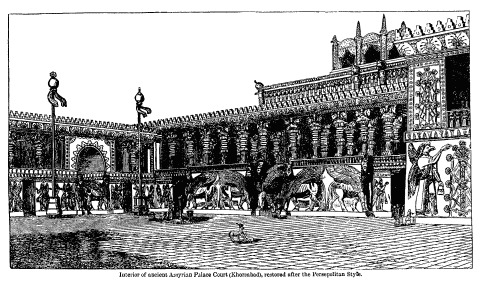
(10.) Civilization of the Assyrians.— This, as has been already observed, was derived originally from the Babylonians. They were a Semitic race, originally resident in Babylonia (which at that time was Cushite), and thus acquainted with the Babylonian inventions and discoveries, who ascended the valley of the Tigris and established in the tract immediately below the Armenian mountains a separate and distinct nationality. Their modes of writing and building, the form and size of their bricks, their architectural ornamentation, their religion and worship, in a great measure, were drawn from Babylon, which they always regarded as a sacred land — the original seat of their nation, and the true home of all their gods, with the one exception of Asshur. Still, as their civilization developed, it became in many respects peculiar. Their art is of home growth. The alabaster quarries in their neighborhood supplied them with a material unknown to their southern neighbors, on which they could represent, far better than upon enamelled bricks, the scenes which interested them. Their artists, faithful and laborious, acquired a considerable power of rendering the human and animal forms, and made vivid and striking representations of the principal occupations of human life. If they do not greatly affect the ideal, and do not, in this branch, attain to any very exalted rank, yet even here their emblematic figures of the gods have a dignity and grandeur which is worthy of remark, and which implies the possession of some elevated feelings. But their chief glory is in the representation of the actual. Their pictures of war, and of the chase, and even sometimes of the more peaceful incidents of human life, have a fidelity, a spirit, a boldness, and an appearance of life, which place them high among realistic schools. Their art, it should be also notcd, is progressive. Unlike that of the Egyptians, which continues comparatively stationary from the earliest to the latest times, it plainly advances, becoming continually more natural and less uncouth, more life-like and less stiff, more varied and less conventional. The latest sculptures, which are those in the hunting-palace of the son of Esarhaddon, are decidedly the best. Here the animal forms approach perfection, and in the striking attitudes, the new groupings, and the more careful and exact drawing of the whole, we see the beginnings of a taste and a power which might have expanded under favorable circumstances into the finished excellence of the Greeks. The advanced condition of the Assyrians in various other respects is abundantly evidenced alike by the representations on the sculptures and by the remains discovered among their buildings. They are found to have understood and applied the arch; to have made tunnels, aqueducts, and drains; to have used the lever and the roller; to have engraved gems; to have understood the arts of inlaying, enamelling, and overlaying with metals; to have manufactured glass, and been acquainted with the lens; to have possessed vases, jars, bronze and ivory ornaments, dishes, bells, ear-rings, mostly of good workmanship and elegant forms in a word, to have attained to a very high pitch of material comfort and prosperity. They were still, however, in the most important points barbarians. Their government was rude and inartificial; their religion coarse and sensual; their conduct of war’ cruel; even their art materialistic and so debasing; they had served their purpose when they had prepared the East for centralized government, and been God’s scourge to punish the people of Israel (Isaiah 10:5-6); they were, therefore, swept away to allow the rise of that Arian race which, with less appreciation of art, was to introduce into Western Asia a more spiritual form of religion, a better treatment of captives, and a superior government.
A fuller account of the customs and antiquities of Assyria than has heretofore been possible may be found in the recent works of Rich, Botta, and Layard; see also Manners, Customs, Arts, and Arms of Assyria, restored from the Monuments, by P. H. Gosse (Lond. 1852); Fresnel, Thomas, and Oppert, Expedition en Mesopotamie (Par. 1858); Outline of the Hist. of Assyria, by Col. Rawlinson (Lond. 1852); Jour. Sac. Lit. 2d ser. 4:373 sq.; Critica Biblica, vol. i; Fergusson, Palaces of Nineveh and Persepolis (Lond. 1851). SEE NINEVEH; SEE BABYLON. On the recent efforts to decipher the cuneiform inscriptions on the Assyrian monuments, see Rawlinson, in the Jour. As. Soc. 12, No. 2; 14, No. 1; Hincks, ib. 12, No. 1; Botta, Mim. sur l’Ecriture Ass. (Par. 1848); Lowenstein, Essai de dechiffr. de l’Ecrit. ssyr. (Par. 1850). SEE CUNEIFORM INSCRIPTIONS. For the geography, see Captain Jones’s paper, in vol. 14 of the Asiatic Society’s Journal (pt. 2); Col. Chesney’s Euphrates Expedition (Lond. 1850). SEE EDEN. For the historical views, see Rawlinson’s Herodotus, vol. i; Brandis’s Rerum Assyriarum Temporaq Emendata; Sir H. Rawlinson’s Contributions to the Asiat. Soc.-Journ. and the Alhenceum; Bosanquet’s Sacred and profane Chronology; Oppert’s Rapport a son Excellence M. le Ministre de l’Instruction; Dr. Hincks’s Contributions to the Dublin University Magazine; Vance Smith’s Exposition of the Prophecies relating to Nineveh and Assyria; and comp. Niebuhr’s Vortrage uber alte Geschichte, vol. i; Clinton’s Fasti Hell. vol. i; Niebuhr’s Geschichte Assurs’s und Babel’s; Gumpach, Abriss der Babylonish- Assyrischen Geschichte (Mannheim, 1854). SEE ASSHUR.