
(
The original name of Joshua was Hoshea (
The conferring of this name on our Lord was not the result of accident, or of the ordinary course of things, but was the effect of a direct divine order (Luke 1:31; 2:21), as indicative of his saving function (Matthew 1:21). Like the other name Immanuel (q.v.), it does not necessarily import the divine character of the wearer. This, however, clearly results from the attributes given in the same connection, and is plainly taught in numerous passages (see especially Romans 1:3, 4; 9:5). for the import and application of the name CHRIST, SEE MESSIAH.
For a full discussion of the name Jesus, including many fanciful etymologies and explanations, with their refutation, see Gesenius, Thes. Heb. 2, 582; Simon. Onom. V. T. p. 519 sq.; Fritzsche, De nomine Jesu (Freiburg, 1705); Clodius, De nom. Chr. et Marioe Arabicis (Lips. 1724); Hottinger, Hist. Orient. p. 153, 157; Seelen, Meditat. exeg. 2, 413; Thiess, Krit. Comment. 2, 395; A. Pfeiffer, De nomine Jesu, in his treatise De Talmude Judoeorum, p. 177 sq.; Baumgarten, Betracht. d. Namens Jesu (Halle, 1736); Chrysander, De vera forma atque emphasi nominis Jesu (Rintel. 1751); Osiander, Harmonia Evangelica (Basil. 1561), lib. 1, c. 6; Chemnitius, De nomine Jesu, in the Thes. Theol. Philol. (Amst. 1702), vol. 2, p. 62; Canini, Disquis. in loc. aliq. N.T., in the Crit. Sac. ix; Gass, De utroque J.C. nomine, Dei filii et nominis (Vratistl. 1840); and other monographs cited in Volbeding’s Index, p. 6, 7; and in Hase’s Leben Jesu, p. 51.
hence it has often been asserted that the historical matter was even at that time no longer extant in an entirely pure state (since the objective and the subjective, both in views and opinions, are readily interchanged in an unscientifically formed style); but that after Jesus had been so gloriously proved to be the Messias, the incidents were improved into prodigies, especially through a consideration of the Old Testament prophecies (Kaiser, Bibl. Theol. 1, 199 sq.). Yet in the synoptical gospels this could only be shown in the composition and connection of single transactions; the facts themselves in the respective accounts agree too well in time and circumstances, and the narrators confine themselves too evidently to the position of writers of memoirs, to allow the supposition of a (conscious) transformation of the events or any such developments from Old Testament prophecy: moreover, if truth and pious poetry had already become mingled in the verbal traditionary reports, the eyewitnesses Matthew and John would have known well, in a fresh narration, how to distinguish between each of these elements with regard to scenes which they had themselves passed through (for memory and imagination were generally more lively and vigorous among the ancients than with us) (Br. ub. Rationalismus, p. 248 sq.; compare Heydenreich, Ueb. Unzulassigkeit d. myth. Auffassung des Histor. im N.T. und im Christenth. Herborn, 1831-5; see Hase, p. 9). Sooner would we suppose that the fertile-minded John, who wrote latest, has set before us, not the pure historical Christ, but one apprehended by faith and confounded with his own spiritual conceptions (Br. über Rational. p. 352). But while it is altogether probable that even he, by reason of his individuality and spiritual sympathy with Jesus, apprehended and reflected the depth and spirituality of his Master more truly than the synoptical evangelists, who depict rather the exterior phenomena of his character, at the same time there is actually nothing contained in the doctrinal discourses of Jesus in John, either in substance or form, that is incompatible with the Christ of the first three evangelists (see Heydenreich, in his Zeitschr fur Predigermiss. 1, pt. 1 and 2); yet these latter represent Jesus as speaking comparatively seldom, and that in more general terms, of his exaltation, dignity, and relation with the Father, whereas that Christ would have explained himself much more definitely and fully upon a point that could not have remained undiscussed, is of itself probable (see Hase, p. 10). Hence also, although we cannot believe that in such representations we are to understand the identical words of Christ to be given (for while the retention of all these extended discourses in the memory is improbable, on the other hand a writing of them down is repugnant to the Jewish custom), yet the actual sentiments of Jesus are certainly thus reported. (See further, Bauer, Bibl. Theol. N.T. 2, 278 sq.; B. Crusius, Bibl. Theol. p. 81; Fleck, Otium theolog. Lips. 1831; and generally Krummacher, Ueber den Geist und die Form der evang. Gesch. Lpz. 1805; Eichhorn, Einleit. 1, 689 sq.; on the mythicism of the evangelists, see Gabler, Neuest. theol. Journ. 7, 396; Bertholdt, Theol. Journ. 5, 235 sq.)
In the Church fathers, we find very little that appears to have been derived from clearly historical tradition, but the apocryphal gospels breathe a spirit entirely foreign to historical truth, and are filled with accounts of petty miracles (Tholuck, Glaubwurdigkeit, p. 406 sq.; Ammon, Leb. Jesu, 1, 90 sq.; compare Schmidt, Einl. ins N.T. 2, 234 sq., and Biblioth. Krit. u. Exegese, 2, 481 sq.). The passage of Josephus (Ant. 18, 3, 3; see Gieseler, Eccles. Hist. § 24), which Eusebius (Hist. Eccl. 1, 11; Demonstr. Ev. 3, 7) was the first among Christian writers to make use of, has been shown (see Hase, p. 12), although some have ingeniously striven to defend it (see, among the latest, Bretschneider, in his Diss. capita theolog. Jud. dogmat. e Josepho collect. Lips. 1812; Bohmert, Ueber des Jos. Zeugniss von Christo, Leipz. 1823; Schodel, Fl. Joseph. de J. Chr. testatus, Lips. 1840), to be partly, but not entirely spurious (see Eichstadt, Flaviani de Jesu Christo testimonii
and he pronounces the evangelical history generally to be “solved.” Thenius has met him with a proof of the evangelical history, drawn from the N.
Test. epistles, in a few but striking remarks (Das Evang. ohne die Evangelien, Leipz. 1843), but A. Ebrard (Viss. Krit. d. evang. Gesch. Frankf. 1842) has fully refuted him in a learned but not unprejudiced work (see also Weisse, in the Jen. Lit.-Zeit. 1843, No. 7-9, 13-15). But this heartless and also peculiarly insipid criticism of Bauer which, indeed, often degenerates into the ridiculous appears to have left no impression upon the literary world, and may therefore be dismissed without further consideration (comp. generally Grimm, Glaubwurdigkeit d. evangel. Gesch. in Bezug auf Strauss und Bauer, Jena, 1845). Lately, Von Ammon (Gesch. d. Leb. Jesu; Leipz. 1842) undertook, in his style of combination, carefully steering between the extremes, a narrative of the life of Jesus full of striking observations. Whatever else has been done in this department (Gfrorer, Geschichte des Urchristenth. Stuttg. 1838; Salvador, Jesus Christ et sa doctrine, Par. 1838) belongs rather to the origin of Christianity than to the data of the life of Jesus. In Catholic literature little has appeared on this subject (Kuhn, Leben Jesus wissensch. bearbeitet, Mainz, 1838; of a more general character are the works of Francke, Leipz. 1838, and Storch, Leipz. 1841). (On the bearing of subjective views upon the treatment of the gospel history, there are the monographs cited in Volbeding, p. 6.) See literature below, and compare the art. SEE CHRISTOLOGY.
a. The year of Christ’s birth (for the general condition of the age, see Knapp, De statu temp. nato Christo, Hal. 1757; and the Church histories of Gieseler, Neander, etc.; on a special point, see Masson, Jani templ. Christo nascente reseratum, Rotterdam, 1700) cannot, as all investigations on this point have proved (Fabricii Bibl. antiquar. p. 187 sq., 342 sq.; Thiess, Krit. Comment. 2, 339 sq.; comp. especially S. van Tilde, de anno, mense et die nati Chr. Lugd. Bat. 1700, praef. J.G. Walch, Jena, 1740; K. Michaeles, Ueber das Geburts- u. Sterbejahr J.C. Wien, 1796, 2, 8), be determined with full certainty (Reccard, Pr. in rationes et limites incertitudinis circa temp. nat. Christi, Reg. 1768); yet it is now pretty generally agreed that the vulgar era (Hamberger, De epochoe Dionys. ortu et auctore, Jen. 1704; also in Martini Thes. Diss. 3, 1, 341 sq.), of which the first year corresponds to 4714 of the Julian Period, or 754 (and latter part of 753; see Jarvis, Introd. to Hist of the Church, p. 54, 610) of Rome (Sanclemente, De vulg. oeroe emendat. Rom. 1793; Ideler, Chronol. 2, 383 sq.), has assigned it a date too late by a few years (see Strong’s Harm. and Expos. Append. 1), since the death of Herod the Great (Matthew 2:1 sq.), according to Josephus (Ant. 17, 8, 1; comp. 14, 14, 5; 17, 9, 3), must have occurred before Easter in B.C. 4 (see Browne’s Ordo Soeclorum, p. 27 sq.). Hence Jesus may have been born in the beginning of the year of Rome 750, four years before the epoch of our era, or even earlier (Uhland, Christum anno ante oer. Vulg. 4 exeunte nature esse, Tubing. 1775; so Bengel, Anger, Wieseler, Jarvis), but in no case later (comp. also Offerhaus, Spicileg. p. 422 sq.; Paulus, Comment. 1, 206 sq.; Vogel, in Gabler’s Journ. f. auserl. theolog. Lit. 1, 244 sq.; and in the Studien der wurtemberg. Geistlichk. 1, 1, 50 sq.). A few passages (as Luke 3:1, 23; Matthew 2:2 sq.) afford a closer determination, SEE CYRENIUS; the latter gave occasion to the celebrated Kepler to connect the star of the Magi with a planetary conjunction (of Jupiter and Saturn), and more recent writers have followed this suggestion (Wurm, in Bengel’s Archiv. 2, 1, 261 sq.; Ideler, Handb. d. Chronol. 2, 399 sq., and Lehrb. d. Chronol. p. 428 sq.; compare also Munter, Stern der Weisen, Copenh. 1827; Klein’s Oppositionsschr. 5, 1, 90 sq.; Schubert, Lehrb. d. Sternkunde, p. 226 sq.), fixing upon B.C. 6 as the true year of the nativity. SEE NATIVITY. But Matthew 2:16 seems to state that the Magi, who must have arrived at Jerusalem soon after the birth of Jesus, had indicated the first appearance of the phenomenon as having occurred a long time previously (probably not exactly two years before), and on that view Jesus might have been born earlier than B.C. 6, the more so inasmuch as the accession of Mars to the same conjunction, occurring in the spring of B.C. 6, according to Kepler, may have first excited the full attention of the Magi. Lately Wieseler (Chronolog. Synopse, p. 67 sq.) has brought down the nativity to the year B.C. 4, and in additional confirmation of this date holds that a comet, which, according to Chinese astronomical tables, was visible for more than two months in this year, was identical with the star of the wise men, at the same time adducing Luke 2:1 sq.; 3:23, as pointing to the same year. But if the Magi had first been incited to their journey by the appearance of that comet, they could not well have designated to Herod as the Messianic star the planetary conjunction of A.U.C. 747 or 748, then almost two years ago, seeing this was an entirely distinct phenomenon. Under this supposition, too, Herod would have made more sure of his purpose if he had put to death children three years old. According to this view, then, we should place Christ’s birth rather in B.C. 7 than B.C. 4. Some uncertainty, however, must always attend the use of these astronomical data. SEE STAR IN THE EAST. As an element in determining the year of the nativity, Luke 3:1, comp. 23, must also be taken into the account. Jesus is there positively stated to have entered upon his public ministry at thirty years of age, and indeed soon after John the Baptist, whose mission began in the fifteenth year of the reign of Tiberius, so that by reckoning back about thirty years from this latter date (August, 781, to August, 782, of Rome, A.D. 28-29), we arrive at about B.C. 3 as the year of Christ’s birth, which corresponds to the statements of Irenaeus (Hoeret. 3, 25), Tertullian (Adv. Jud. 8), and Eusebius (Hist. Ev. 1, 5), that Jesus was born in the year 41 (42) of the reign of Augustus, i.e. 751 of Rome, or B.C. 3 (Ideler, Chronolog. 2, 385). As Luke’s language in that passage is somewhat indefinite (“about,”
of Rome. If, however, we suppose (but see Browne, Ordo Soeclorum, p. 67) the joint reign of Tiberius with Augustus, i.e. his association with him in the government especially of the provinces (Vell. Paterc. Hist. Rom. 2, 121; Sueton. 3, 20, 21; Tacitus, Annal. 1, 3; Dio Cass. Hist. Rom. 2, 103), three and a half years before his full reign (Janris, Introd. p. 228-239), to be meant, we shall again be brought to about B.C. 6, or possibly 7, as the year of the nativity. The latest conclusion of Block (Das wahre Geburtsjahr Christi, Berl. 1843), that Jesus was born in the year 735 of Rome, or nineteen years before the beginning of the vulgar era, based upon the authority of the later Rabbins, does not call for special examination (yet see Wieseler, Chronol. Synopse, p. 132). SEE ADVENT.
The month and day of the birth of Christ cannot be determined with a like degree of approximation, but it could not, at all events, have fallen in December or January, since at this time of the year the flocks are not found in the open fields during the night (Luke 2:8), but in pens (“ the first rain descends the 17th of the month Marchesvan [November], and then the cattle returned home; nor did the shepherds any longer lodge in huts in the fields,” Gemara, Nedar. 63); moreover, a census (
b. The year of Christ’s crucifixion is no less disputed (comp. Paulus, Comment. 3, 784 sq.). The two extreme limits of the date are the above- mentioned 15th year of Tiberius, in which John the Baptist began his career (Luke 3:1), i.e. Aug. 781 to Aug. 782 of Rome (A.D. 28-29), and the year of the death of that emperor, 790 of Rome (A.D. 37), in which Pilate had already left the province of Judaea. Jesus appears to have begun his public teaching soon after John’s entrance upon his mission; for the message of the Sanhedrim to John, which is placed in immediate connection with the beginning of Christ’s public ministry (John 1:19; comp. 29:35; 2:1), and comes in just before the Passover (John 2:12 sq.), must have been within a year after John’s public appearance. This being assumed, a further approximation would depend upon the determination of the number of Passovers which Jesus celebrated during his ministry; but this itself is quite a difficult question (see under No. 5, below). It is now generally conceded that he could not well have passed less than three Paschal festivals, and probably not more than four (i.e. one at the beginning of each of Christ’s three years, and a fourth at the close of the last); thus we ascertain as the terminus a quo of these festivals the year A.D. 28, and as the probable terminus ad quem the year A.D. 32; or, on the supposition (as above) that the joint reign of Tiberius is meant, we have as the limits of the Passovers of Jesus A.D. 25-29. This result would be rendered more definite and certain if we could ascertain whether in the last of these series of years (A.D. 29 or 32) the Jewish Passover fell on a Friday (Thursday evening and the ensuing day), as this was the week day on which the death of Christ is generally held to have taken place. There have been various calculations by means of lunar tables (Linbrunn, in the Abhandlung der bayerschen Akademie der Wiss. vol. 6; Wurm, in Bengel’s Archiv. 2, 1, 292 sq.; Anger, De temporumn in Act. Apost. ratione ciss. 1, Lips. 1830, p. 30 sq.; Browne, Ordo Soeclorum. Lond. 1844, p. 504), to determine during which of the years of this period the Paschal day must have occurred on Friday (see Strong’s Harm. and Exposit. Append. 1, p. 8 sq.); but the inexactness of the Jewish calendar makes every such computation uncertain (Wurm, ut sup. p. 294 sq.). Yet it is worthy of notice that the two most recent investigations of Wurm and Anger both make the year A.D. 31, or 784 of Rome, to be such a calendar year as we require. Wieseler, Chronol. Synops. p. 479), on the other hand, protests against the foregoing computations, and insists that in A.D. 30 alone the Paschal day fell on Friday. According to other calculations, A.D. 29 and 33 are the only years of this period in which the Paschal eve fell on Thursday (see Browne, Ordo Soeclorum, p. 55), while so great discrepancy prevails between other computations (see Townsend’s Chronological N.T. p. *159) that little or no reliance can be placed upon this argument (see Strong’s Harm. and Exposit. Append. 1, p. 8 sq.). SEE PASSOVER. The opinion of some of the ancient writers (Irelenus, 2, 22, 5), that Jesus died at 40 or 50 years of age (compare John 8:57), is altogether improbable (see Pisanski, De errore Irenoei in determinanda oetate Christi, Regiom. 1777). The most of the Church fathers (Tertull. Adv. Jud. 8; Lactantius, Institut. 4, 10; Augustine, Civ. dei, 18, 54; Clem. Alex. Stromn. 1, p. 147, etc.) assign but a single year as the duration of Christ’s ministry, and place his death in the consulship of the two Gemini (VIII Cal. April. Coss. C. Rubellio Gemino et C. Rufio Gemino), i.e. 782 of Rome, A.D. 29, the 15th year of Tiberius’s reign, which Ideler (Chronology, 2, 418 sq.) has lately (so also Browne, Ordo Soeclorum, p. 80 sq.) attempted to reconcile with Luke 3:1 (but see Seyffarth, Chronol. Sacra, p. 115 sq.; Eusebius, in his Chronicles Armen. 2, p. 264, places the death of Jesus in the 19th year of Tiberius, which Jerome, in his Latin translation, calls the 18th; on the above reckoning of the fathers, see Petavius, Animadvers. p. 146 sq.; Thilo, Cod. Apocr. 1, 497 sq.). On the observation of the sun at the crucifixion (Matthew 27:45; Mark 15:33; Luke 23:44), SEE ECLIPSE, (On the chronological elements of the life of Jesus, see generally Hottinger, Pentas dissertat. bibl.-chronol. p. 218 sq.; Voss, De annis Christi dissertat. Amst. 1643; Lupi, De notis chronolog. anni mortis et nativ. J.C. dissertat. Rom. 1744; Horix, Observat. hist. chronol. de annis Chr. Mogunt. 1789; compare Volbeding, p. 20; Hase, p. 52.) SEE CHRONOLOGY.
(a) Matthew traces the lineage through Joseph, Luke gives the maternal descent (comp. also Neander, p. 21); so that the person called Eli in Luke 3:23, appears to have been the father of Mary (see especially Helvicus, in Crenii Exercitat. philol. hist. 3, p. 332 sq.; Spanheim, Dubia evang. 1, 13 sq.; Bengel, Heumann, Paulus, Kuinol, in their Commentaries; Wieseler, in the Studien u. Krit. 1845, p. 361 sq.; on the contrary, Bleek, Beitrage z. Evangelienkrit. p. 101 sq.). But, in the first place, in that case Luke would hardly have written so expressly “the son of Eli” (
(b) Some assume that the proper father of Joseph was Eli: he, as a brother, or (as the difference of the names up to Salathiel necessitates) as the nearest relative (half-brother?), had married Mary, the wife of the deceased childless Jacob, and according to the Levirate law (q.v.) Joseph would appear as the son of Jacob, and would, in fact, have two fathers (so Ambrosius); or conversely, we may suppose that Jacob was the proper father of Joseph, and Eli his childless deceased uncle (comp. Julius Afric. in Eusebius, Hist. Ev. 1, 7; Calixtus, Clericus). This hypothesis, which still conflicts with the Levirate rule that only the deceased is called father of the posthumous son (Deuteronomy 25:6), Hug (Einl. 2, 268 sq.), has been so modified as to presume a Levirate marriage as far back as Salathiel, by which the mention of Salathiel and Zerubbabel in both lists would be explained; and Hug also introduces such a marriage between the parents of Joseph, and still another among more distant relatives. This is ingenious, but too complicated (see generally Paulus, ut sup. p. 260). If a direct descent of Jesus could have been laid down from David, there remains no reason why, when the natural extraction of the Messiah straight from David was so important, the very evangelist who wrote immediately for Jewish readers should have traced the indirect lineage. But if so many as three Levirate marriages had occurred together (as Hug thinks), we should suppose that Matthew, on account of the infrequency of such a case, would have given his readers some hint, or at least not have written (ver. 16) “begat” (
(c) If both the foregoing explanations be rejected, there remains no other course than to renounce the attempt to reconcile the two family lines of Jesus, and frankly acknowledge a discrepancy between the evangelists, as some have done (Stroth, in Eichhorn’s Repert. 9, 131 sq.; Ammon, Bibl. Theol. 2, 266; Thiess, Krit. Comment. 2, 271 sq.; Fritzsche, ad Matthew p. 35; Strauss, 1, 105 sq.; De Wette, B. Crusius, Alford, on Luke 3). In the decayed family of Joseph it might not have been possible, especially after so much misfortune as befell the country and people, to recover any written elements for the construction of a family register back to David. Were the account of Julius Africanus (in Eusebius, 1, 7; compare Schottgen, Hor. Hebr. p. 885), that king Herod had caused the family records of the Jews to be burned, correct, the want of such information would be still more evident (but see Wetstein, 1, p. 232; Wieseler, in the Stud. u. Kritik. 1845, p. 369). In that case, after the need of such registers had arisen, persons would naturally have set themselves to compiling them from traditional recollections, and the variations of these may readily have resulted in a double lineage. But even on this view it has been insisted that both lines present the descent of Joseph and not of Mary, since it was unusual to exhibit the maternal lineage, and the Jews would not have regarded such an extraction from David as the genuine one. There are, at all events, but two positions possible: either the supernatural generation of Jesus by the Holy Spirit was admitted, or Jesus was considered a son of Joseph (Luke 3:33). In the latter case a family record of Joseph entirely sufficed for the application of the O.T. oracles to Jesus; in the former case it has been conceived that such a register would have been deemed superfluous, and every natural lineage of Jesus from David (Romans 1:3) would have thrown his divine origin into the background. This has been alleged as the reason why John gives no genealogy at all, and generally says nothing of the extraction of Jesus from the family of David (see Von Ammon, Leb. Jes. 1, 179 sq.). The force of these arguments, however, is greatly lessened by the consideration that the early Christians, in meeting the Jews, would be very anxious, if possible, to prove Christ’s positive descent from David through both his reputed and his real parent; the more so, as the former was avowed to be only nominally such, leaving the whole actual lineage to be made out on the mother’s side. (See generally Baumgarten, De genealogia Chr. Hal. 1749; Durr, Genealogia Jesu, Gott. 1778; Busching’s Harmon. d. Evang. p. 187 sq., 264 sq.) SEE GENEALOGY OF CHRIST.
(a) “John, who stands in so near a relation to Jesus, and must have known the family affairs, relates nothing at all of this wonderful birth, although it was very apposite to his design.” But this evangelist shows the high dignity of Jesus only from his discourses, the others from public evidences and a few astonishing miracles; moreover, his prologue (1, 1-18) declares dogmatically pretty much the same thing as the synoptical gospels do historically in this respect. (Compare also the deportment of Mary, John 2:3 sq.; see Neander, p. 16. sq.)
(b) “Neither Jesus nor an apostle ever appeals in any discourse to this circumstance. Paul always says simply that Jesus was born ‘of the seed of David’ (Romans 1:3; 2 Timothy 2:8); once (Galatians 4:4), more definitely, ‘of a woman’ (
(c) “Mary calls Joseph, without qualification, the father of Jesus (Luke 2:48), and also among the Jews Jesus was generally called Joseph’s son (Matthew 13:55; Mark 6:3; Luke 3:23; 4:22; John 1:46; 6:42).” This last argument is wholly destitute of force; but Mary might naturally, in common parlance, call Joseph Jesus’ father, just as, in modem phrase, a foster-father is generally styled father when definiteness of expression is not requisite.
(d) “The brothers of Jesus did not believe in him as the Messiah (John 7:5), which would be inexplicable if the Deity had already indicated him as the Messiah from his very birth.” Yet these brothers had not themselves personally known the fact; and it is, moreover, not uncommon that one son in a family who is a general favorite excites the ill will of the others to such a degree that they even deny his evident superiority, or that brothers fail to appreciate and esteem a mentally distinguished brother.
(e) “History shows in a multitude of examples that the birth of illustrious men has been embellished with fables (Wetstein, N.T. 1, p. 236); especially is the notion of a birth without connection with a man (
Bethlehem, too (Wagner, De loco nat. J. Chr. Colon. Brandenb. 1673), as the place of Christ’s birth, has been deemed to belong to the mythical dress of the narrative (comp. Micah 5:1; see Thess, Krit. Comment. 2, 414), and it has therefore been inferred that Jesus was not only begotten in Nazareth, but also born there (Kaiser, Bibl. Theol. 1, 230) — which, nevertheless, does not follow from John 1:46. That Jesus was born in Bethlehem is stated in two of the evangelical accounts (Matthew 2:1; Luke 2:4), as may also be elsewhere gathered from the events which follow his birth. But a more direct discrepancy between Matthew and Luke (Hase, p. 44), respecting Joseph’s belonging to Bethlehem (Matthew 2:22, 23; Luke 1:26; 2:4), cannot be substantiated (compare generally Gelpe, Jugendgesch. d. Herrn, Berne, 1841.) SEE BETHLEHEM.
(a) Mary, Jesus’ mother’s sister (John 19:25). According to the usual apprehension of this passage, SEE SALOME, she was married to one Clopas or Alphaeus (q.v.), and had as sons James (q.v.) the younger (Acts 1:13) and Joses (Matthew 27:56; Mark 15:40). SEE MARY.
(b) Elizabeth, who is called the relative (
(c) Brethren of Jesus (
(d) Sisters of Jesus are mentioned in Matthew 13:56; Mark 6:3 (in Mark 3:32, the words
(e) Finally, an ecclesiastical tradition makes Salome, the wife of Zebedee, and mother of the apostles James and John (Mark 15:40; 16:1, etc.), to have been a relative of Jesus. (See Hase, p. 55.) SEE SALOME.
On the other hand, John’s Gospel shows (comp. Jacobi, Zur Chronol. d. Lebens J. im Evang. Joh. in the Stud. u. Krit. 1838, 4, 845 sq.) that Jesus was not only oftener, but generally in Judaea (whence he once traveled through Samaria to Galilee, John 4:4; compare his return, Luke 17:11), namely, in the holy city Jerusalem (but this difference agrees with the respective designs of the several gospels; see Neander, p. 385 sq.), and informs us of five Jewish festivals which Jesus celebrated at Jerusalem. The first, occurring soon after the baptism of Jesus (John 2:13), is a Passover; the second (John 5:1) is called indefinitely “a feast of the Jews” (
we are also to understand a Passover (Paulus, Comm. 1, 901 sq.; Suskind, in Bengel’s Archiv. 1, 182 sq.; B. Crusius, ad loc.; Seyffarth, Chronol. Sacra, p. 114; Robinson, Harmony, p. 193), which, however, is not certain (Lücke, ad loc.; Anger, De temp. in Act. Apost. ratione, 1, 24 sq.; Jacobi, ut sup. p. 864 sq.), we must assign a period of three and a half years (Eusebius, 1, 10, 3), as lately Seyffarth has done (Summary of recent Discoveries in Chronol. N.Y. 1857, p. 183), although on the most singular grounds (see Alford, Commentary on John 5:1). Otherwise the evangelists hardly afford more than two years and a few months (see Anger, ut sup. p. 28; Hase, p. 17 sq.) to the public labors of Jesus (see generally Laurbeck, De annis ministerii Chr., Altdorf, 1700; Korner, Quot Paschata Christus post baptism. celebraverit, Lips. 1779; Pries, De numero Paschatum Christi, Rostock, 1789; Lahode, De die et anno ult. Pasch. Chr. Hal. 1749; Marsh’s remarks in Michaelis’s Introd. 2, 46 sq.). Again, as the apostles were not uninterruptedly in company with Jesus, the time of their proper association with him might be still further reduced somewhat, although we can not (with Hanlein, De temporis, quo J.C. cume Apostol. versatus est, duratione, Erl. 1796) assume it to have been barely some nine months. Under these three (or four) Paschal festivals writers have repeatedly endeavored, for historical and particularly apologetic purposes, to arrange all the single occurrences which the first evangelists mention without chronological sequence, and so to obtain a complete chronological view of Jesus’ entire journeys and teaching. Yet, notwithstanding so great a degree of ingenuity has been expended upon this subject, none of the Gospel Harmonies hitherto constructed can be regarded as more than a series, of historical conjectures, since the narrative of the first three evangelists presents but little that can guide to a measurably certain conclusion in such an arrangement, and John himself does not appear to relate the incidents in strictly chronological order according to these Passovers (see generally Eichhorn, Einl. ins N.T., 692 sq.). The most important of these attempts are, Lightfoot, Chronicle of the O.T. and N.T. Lond. 1655; Doddridge, Expositor of the N.T. London, 1739; Rus, Harmonia Evangelistar. Jen. 1727; Macknight, Harmony of the four Gospels, London, 1756, Latine fecit notasque adjecit Ruckersfelder, Brem. 1772; Bengel, Richt. Harmonie der 4 Evangel. 3d edit. Tubing. 1766; Newcome, Harmony of the Gospels, Dublin, 1778; Paulus, Comment. 1, 446 sq.; 2, 1 sq., 384 sq.; 3, 82 sq.; Kaiser, Ueb. die synopt. Zusammenstell. der 4 Evang. Nuremb. 1828; Clausen, Quat. evangel. tabuloe synopt. sec. rationem tempor. Copenhagen, 1829; Wieseler, Chronolog. Synopse der 4 Evang. Hamb. 1843; Townsend’s Chronol Arrang. of the N. Test. Lond. 1821, Bost. 1837; Greswell, Harmonia Evang. Lond. 1830; Robinson, Harmony of the Gospels (Greek), Bost. 1845 (Engl. id.); Tischendorf, Synopsis Evangel. Leipz. 1851; Strong, Harmony of the Gospels (English), N.Y. 1852 (Greek), ib. 1854; Stroud, Greek Harmony, Lond. 1853. SEE HARMONIES.
Respecting the characteristics of Jesus’ teaching (see especially Winkler, Ueber J. Lehrfahigkeit und Lehrart, Leipz. 1797; Behn, Ueb. die Lehrart Jesu u. seiner Apostel, Lubeck, 1791; Hauff, Bemerkungen über die Lehrart Jesu, Offenbach, 1788; H. Ballauf, Die Lehrart Jesu als vortrefflich gezeigt, Hannov. 1817; H.N. la Cle, De Jesu Ch. instituendi methodo horn. ingenia excolente, Groning. 1835; Ammon, Bibl. Theol. 2, 328 sq.; Planck, Geschichte d. Christenth. 1, 161 sq.; Hase, Leben Jes. p. 123 sq.; Neander, p. 151 sq.; Weisse, 1, 376 sq.), we may remark that all his discourses, which were delivered sometimes in the synagogues (Matthew 13:54; Luke 4:22, etc.), sometimes in public places, and even in the open field, sometimes in the Temple court, were suggested on the occasion (John 4:32 sq.; 7:37 sq.), either by some transaction or natural phenomenon, or else by some recital (Luke 13:1), or expression of others (Matthew 8:10). He loved especially to clothe his sentiments in comparisons (see Greiling, p. 201 sq.), parables (Matthew 13:11 sq., 34 sq.) (for these are preeminently distinguished for simplicity, conciseness, natural beauty, intelligibleness, and dignity; see especially Unger, De parabolar. Jesu natura, intepretatione, usu, Leipz. 1828), allegories (John 6:32 sq.; 10; 15), and apothegms (Matthew 5), sometimes also paradoxes (John 2:19; 6:53; 8:58), which exactly suited the comprehension of his audience (Mark 4:33; Luke 13:15 sq.; 14:5 sq.); and he even adapted the novelty and peculiarity of his doctrines to familiar Jewish forms, which in his mouth lose that ruggedness and unaesthetic character in which they have come down to us in the Talmud (comp. Weisse, De more Domini acceptos a magistris Jud. loquedi ac disserendi modos sapienter emendandi; Viteb. 1792). SEE ALLEGORY; SEE PARABLE. In contests with learned Jews, Jesus knew how, by simple clearness of intellect, to defeat their arrogant dialectics, and yet was able to pursue their own method of inferential argument (Matthew 12:25). When they proposed to him captious questions, he brought. them, not unfrequently by similar questions, mostly in the form of a dilemma (Matthew 21:24; 22:20; Luke 10:29 sq.; 20:3 sq.), or by appeal to the explicit written law or to their sacred history (Matthew 9:13; 12:3 sq.; 19:4 sq.; Luke 6:2 sq.; 10:26 sq.; 20:28 sq.), or by analogies from ordinary life (Matthew 12:10 sq.), to maintain silence, or put them to embarrassment with all their sagacity and legal zeal (Matthew 22:42 sq. John 8:3 sq.); sometimes he disarmed them by the exercise of his miraculous power (Luke 5:24). With a few exceptions, John alone assigns longer speeches of a dogmatic character to Jesus; nor is it any matter of surprise that the Wisdom which delivered itself to the populace in maxims and similes should permit itself to be understood, in the circle of the priests and those erudite in the law, connectedly and mystically on topics of the higher gnosis, although even in John, of course, we can not expect the ipsissima verba. In a formal treatment, moreover, his representations, especially those addressed to the people, could not be free from accommodation (P. van Hemert, Ueb. Accommod. im N.T. Dortmund and Leipz. 1797); but whether he made use of the material (not merely negative) species of accommodation is not a historical, but a dogmatic question (comp. thereon Bretschneider, Handb. d. Dogm. 1, 420 sq.; Wegschneider, Institut. p. 119 sq.; De Wette, Sittenlehre, 3, 131 sq.; Neander, p. 216 sq.). SEE ACCOMMODATION. Like the O.T. prophets, he sometimes also employed symbolical acts (John 13:1 sq., 20, 22; comp. Luke 9:47 sq.). A dignified expression, a keen but affectionate look, a gesticulation reflecting the inward inspiration (Hegemeister, Christum gestus pro concione usurpasse, Servest. 1774), may have contributed not a little to the force of his words, and gained for him, in opposing the Pharisees and lawyers, the eulogium of eloquence (compare John 7:46; 18:6; Matthew 7:28 sq.). The tuition which Jesus imparted to the apostles (comp. Greiling, p. 213 sq.), was apparently private (Matthew 13:11 sq.; see Colln, Bibl. Theol. 2, 14). SEE APOSTLE. Finally, Jesus commonly spoke Syro-Chaldee (comp. e.g. Mark 3:17; 5:41; 7:34; Matthew 27:47; see Malala, Chronograph. p. 13), like the Palestinian Jews generally, SEE LANGUAGE, not Greek (Diodati, De Christo Groece loquente, Neap. 1767, translated in the Am. Bibl. Repos. Jan. 1844, p. 180 sq.; comp. on the contrary, Ernesti, Neueste theol. Bibl. 1, 269 sq.), although he might have understood the latter language, or even Latin (Wernsdorf, De Christo Latine loquente, Viteb.; see generally Reiske, De lingua vern. J. C. Jen. 1670; Bh. de Rossi, Della lingua propria di Christo, Parm. 1773; Zeibich, De lingua Judoeor. temp. Christi et. Apost. Vitebsk, 1791; Wisemann, in his Hor. Syriac. Rom. 1828). No writings of his are extant (the spuriousness of the so-called letter to the king of Edessa, given by Eusebius, 1, 13, is evident; comp. also Rohr’s Krit. Prediger-biblioth. 1, 161 sq. SEE ABGAR: the alleged written productions of Jesus may be seen in Fabricii Cod. Apocr. 1, 303 sq.), nor was there need of any, since he had provided for the immediate dissemination of his doctrines through the apostles, and he wished even to turn away attention from the literature of the age to the spirit and life of a thorough piety (compare Hauff, Briefe d. Werth der schriftl. Rel.-Urkund. betreffnd, 1, 94 sq.; Sartorius, Cur Christus scripti nihil reliquerit, Leipz. 1815; Witting, Warum J. nichts Schriftl. hinterlassen, Bschw. 1822; Giesecke, Warum hat J.C. über sich u. s. Relig. nichts Schriftl. hinterlassen, Lineb. 1823; B. Crusius, Bibl. Theol. p. 22 sq.; Neander, p. 150; comp. Hase, p. 11). Jesus has been improperly entitled a Rabbi, or high rank of religious teacher (
Another point is entitled to consideration in estimating their judicial action. The Sanhedrim’s broader denunciation of Jesus before Pilate as a usurper of royal power, and their charging him with treason (crimen loesoe majestatis) (Matthew 27:11; Mark 15:2; Luke 23:2; John 18:33), is explained by the fact that the Messiah was to be a theocratic king, and that the populace for a few days saluted Jesus with huzzas as the Son of David (Matthew 21; John 12). Jesus certainly did not aspire to royalty in the political sense, as he declared before Pilate (John 18:36 sq.): this the Sanhedrim, if they had been dispassionate judges, must have been assured of, even if they had not previously inquired or ascertained how far Jesus was from pretensions to political authority. The sentence itself is therefore less to be reprobated than that the high court did not, as would have been worthy itself, become better informed respecting the charges; their indecorous haste evinces an eagerness to condemn the prisoner at all hazards, and their vindictive manner clearly betrays their personal malice against him. That Pilate passed and executed the sentence of death contrary to his better judgment as a civil officer is beyond all doubt. SEE PILATE.
That Jesus passed through a merely apparent death has been supposed by many (see especially Bahrdt, Zwecke Jesu, 10, 174 sq.; Paulus, Comment. 3, 810 sq., and Leben Jesu, 1, 2, 281 sq.; on the contrary, see Richter, De morte Servatoris in cruce, Gott. 1757, also in his Diss. 4 med. p. 1 sq.; Gruner, De Jes. C. morte vera, non simulata, Jena, 1805; Schmidtmann, Medic.-philos. Beweis, dass J. nach s. Kreuzigung nicht von einer todtahnl. Ohnmacht befallen gewesen, Osnabr. 1830). The piercing of the side of Jesus by the lance of a Roman soldier (John 19:34; his name is traditionally given as Longinus, see Thilo, Apocr. p. 586) has been regarded as the chief circumstance upon which everything here depends (Triller, De mirando lateris cordisque Christi vulnere, in Gruner’s Tract. de doemoniacis, Jena, 1775; Eschenbach, Scripta med.-bibl. p. 82 sq.; Bartholini, De latere Christi aperto, Lugd. Bat. 1646), inasmuch as before this puncture the above cited physicians assume but a torpor and swoon, which might seem the more probable because crucifixion could hardly have caused death in so short a time (Mark 15:44). SEE CRUCIFY. But the account of the wound in the side is not such as to allow the question to be by that means fully and absolutely determined (see Briefe über Rationalismus, p. 236 sq.), since the evangelist does not state which side (
The fact of the return of Jesus alive from the grave (comp. Ammon, De vera J. C. reviviscentia, Erlang. 1808; Griesbach, De fontib. unde Evangel. suas de resurrectione Domini narrationes hauserint, Jena, 1783; Friedrich, in Eichhorn’s Biblioth. 7, 204 sq.; Doderl. De J.C. in vit. reditu, Utr. 1841)
is not invalidated by Strauss’s ingenious hypotheses (2, 645; see Hase, p. 212; Theile, p. 105 sq.; comp. Kihn, Wie ging Ch. durch des Grabes Thur, Strals. 1838); but if Jesus had been merely dead in appearance, so delicate a constitution, already exhausted by sufferings before crucifixion, would certainly not have revived without special — that is, medical — assistance (Neander, p. 708): in the cold rock vault, in an atmosphere loaded with the odor of aromatics, bound hand and foot with grave clothes, in utter prostration, he would, in the ordinary course of things, have rather been killed than resuscitated. His return to life must therefore be regarded as a true miracle. SEE RESURRECTION. On the grave of Jesus, SEE GOLGOTHA.
After he had risen (he lay some thirty-six hours in the grave; not three full days, as asserted by Seyffarth, Summary of Chronol. Discov. N.Y. 1857, p. 188), he first showed himself to Mary Magdalene (Matthew 28:9. Mark 16:9; John 20:14; but about the same hour to the other women, see Strong’s Greek Harmony, p. 364), then to his apostles in various places in and about Jerusalem (Luke 24:13 sq., 36 sq.; John 20:19 sq.), and was recognized by them — not immediately, it is true (for the few past days of suffering may have considerably disfigured him bodily), but yet unequivocally — as their crucified teacher (Neander, p. 715 sq.), and even handled, although with some reserve (Luke 24:37; John 21:12). He did not appear in public; had he done so, his enemies would have found opportunity to remove him a second time out of the way, or to represent him to the people as a sham Jesus: his resurrection could have its true significance to his believers only (see generally Jahn, Nachtrage, p. 1 sq.). After a stay of 40 days, he was visibly carried up into the sky before the eyes of his disciples (Luke 24:51; Acts 1:9. Mark 16:19, is of doubtful authenticity). Of this, three evangelical witnesses (Matthew, Mark, and John) relate nothing (for very improbable reasons of this, see Flatt’s Magaz. 8, 55 sq.), although the last implies it in the words of Jesus, “I ascend to my Father,” and closes his Gospel with the last interview of Jesus in Galilee, at the Sea of Tiberias (John 21; compare Matthew 28:16). The apostles, in the doctrinal expositions, occasionally allude to this ascension (
His aspect terrible in rebuke, placid and amiable in admonition, cheerful without losing its gravity: a person never seen to laugh, but often to weep,” etc. (compare Niceph. 1, 40). (See Volbeding, p. 6.) The description given by Epiphanius (Monach. p. 29, ed. Dressel) has lately been discovered by Tischendorf (Cod. Ven. cl. 1, cod. 3, No. 12, 000) in a somewhat different and perhaps more original form (in Greek), as follows: “But my Christ and God was exceedingly beautiful in countenance. His stature was fully developed, his height being six feet. He had auburn hair, quite abundant, and flowing down mostly over his whole person. His eyebrows were black, and not highly arched; his eyes brown, and bright. He had a family likeness, in his fine eyes, prominent nose, and good color, to his ancestor David, who is said to have had beautiful eves and a ruddy complexion. He wore his hair long, for a razor never touched it; nor was it cut by any person, except by his mother in his childhood. His neck inclined forward a little, so that the posture of his body was not too upright or stiff. His face was full, but not quite so round as his mother’s; tinged with sufficient color to make it handsome and natural; mild in expression, like the blandness in the above description of his mother, whose features his own strongly resembled.”
This production bears evident marks of being a later fabrication (see Gabler, 2 Progr. in authentiam epist. Lentuli, etc., Jen. 1819, 1822; also in his Opusc. 2, 638 sq.). There is still another notice of a similar kind (see the Jen. Lit.-Zeit. 1821, sheet 40), and also an account of the figure of Jesus, which the emperor Alexander Severus is said to have had in his lararium or household shrine (see Zeibich in the Nov. Miscell. Lips. 3, 42 sq.). SEE CHRIST, IMAGES OF.
From the New Test. the following particulars only may be gathered: Jesus was free from bodily defects (for so much is implied in the type of an unblemished victim under the law, and otherwise the people would not have recognized in him a prophet, while the Pharisees would have been sure to throw any physical deformity in his teeth), but his exterior could have presented nothing remarkable, since Mary Magdalene mistook him for the gardener (John 20:15), and the two disciples on the way to Emmaus (Luke 24:16), as well as the apostles at his last appearance by the Sea of Gennesareth (John 21:4 sq.), did not at first recognize him; but his form then probably bore many permanent marks of his severe sufferings. The whole evangelical narrative indicates sound and vigorous bodily health. In look and voice he must have had something wonderful (John 18:6), but at the same time engaging and benevolent: his outward air was the expression of the high, noble, and free spirit dwelling within him. The assertions of the Church fathers (Clem. Alex. Poedag. 3, 92; Strom. 6, 93; Origen, Cels. 6, 327, ed. Spenc.) that Christ had an unprepossessing appearance are of no authority, being evidently conformed to Isaiah 53 (but see Piiartii Assertio de singulari J. Ch. pulchritudine, Par. 1651; see generally, in addition to the above authorities, F. Vavassor, De forma Christi, Paris, 1649; on the portraits of Jesus, Reiske, De imaginibus Christi, Jena, 1685; Jablonsky, Opusc. edit. Te Water, 3, 377; Junker, Ueber Christuskopfe, in Ieusel’s Miscell. artist. Inh. pt. 25, p. 28 sq.; Ammon, Ueb. Christuskopfe, in his Magazin. f. christl. Pred. 1, 2, 315 sq.; Tholuck, Literar. Anzeig. 1834, No. 71; Grimm, Die Sage und Ursprung der Christusbilder, Berl. 1843; Mrs. Jameson, Hist. of our Lord exemplified in Works of Art [Lond. 1865]). (See further in Volbeding, p. 19; Hase, p. 65; Meth. Quart. Rev. Oct. 1862, p. 679.)
The moral and religious character of Jesus (humanly considered), which even in the synoptical gospels, that are certainly chargeable with no embellishment, appears in a high ideality, has never yet been depicted with accurate psychological skill (see Volbeding, p. 35), but usually as a model of virtue in general (yet see Jerusalem, Nachgelass. Schrift, 1, 75 sq.; Greiling, p. 9 sq.; E.G. Winckler, Vers. e. Psychocographie Jesu, Lpz. 1826; Ullmann, Sundlosig. Jes. p. 35 sq.; Ammon, Leb. Jes. 1, 240 sq.; Thiele, in the Darmst. Kirch.-Zeit. 1844, No. 92-94). (Comp. Hase, p. 62, 64.) On the (choleric) temperament of Jesus, see J.G. Walch, De temperamento Christi hom. Jen. 1753. Deep humility before God (Luke 18:19), and ardent love towards men in view of the determined sacrifice (John 10:18), were the distinguishing traits of his noble devotion, while the divine zeal that stirred his great soul concentrated all his virtues upon his one grand design. Jesus appears as the harmonious complete embodiment of religious resignation; but this was so far from being a result of innate weakness (although Jesus might have had a slender physical constitution), that his natural force of character subsided into it (for examples of high energy in feeling and act, see John 2:16 sq.; 8:44 sq.; Matthew 16:23; 23:5, etc.). Everywhere to this deep devotion was joined a clear, prudent understanding — a combination which alone can preserve a man of sensibility and activity from the danger of becoming a reckless enthusiast or a weak sentimentalist. This is most unmistakably exhibited in the account of his passion and death. Neither do we find in Jesus any trace of the austerity and gloomy sternness of other founders of religion, or even of his contemporary the Baptist (Matthew 11:18 sq.). In the midst of eager listeners in the public streets or in the Temple, he spoke with the high dignity of a messenger of God; yet how affectionately sympathetic (John 11:35), how solicitous, how self-sacrificing did he exhibit himself in the bosom of the family, in the dear circle of his friends! What tender sympathy expressed itself in him on every occasion (Luke 7:13; Matthew 9:36: 14:14; 30:34). He was both (compare Romans 12:15) tearful among the tearful (John 11:35), and cheerful among the cheerful (John 2:1 sq.; Luke 7:34). On this very account the character of Jesus has at all times so irresistibly won the hearts of the good and noble of all people, since it evinces not merely the rarest magnanimity, such as to cause amazement, but at the same time the purest, most disinterested humanity, and thus presents to the observer not simply an object of esteem, but also of love. The history of Jesus’ life is equally interesting to the child and the full-grown man, and certainly his example has effected at all times not less than his precepts. In accordance with this unmistakable sum of his character, certain single passages of the Gospels (e.g. Matthew 12:46 sq.; 15:21 sq.; John 2:4), which, verbally apprehended, SEE CANA, might perplex us concerning Jesus (comp. J.F. Volbeding, Utrum Christus matrem genusque suum dissimulaverit et despexerit, Viteb. 1784; K.J. Klemm, De necessitudine J. Christo c. consanguineis intercedente, Lips. 1846), may be more correctly explained see Ammon, Leb. Jesu, 1, 243 sq.), and may be placed in harmony with others (e.g. Luke 2:51; compare Lange, De subjectione Chr. sub parentib. Lips. 1738). SEE ENSAMPLE.
The task of the world’s redemption, acting as an ever present burden upon the Savior’s mind, produced that pensiveness, not to say sadness, which was a marked characteristic of all his deportment. Rarely did his equanimity rise to exuberant joy, and that only in connection with the great ruling object of his life (Luke 10:21); oftener did it experience dejection of spirit (John 12:27), at times to the depths of mental anguish (Mark 14:34). SEE AGONY. It was this interior pressure that so frequently burst forth in sighs and tears (John 11:33; Luke 19:41), and made Jesus the ready sympathizer with human affliction (John 11:35). It is such spiritual and unselfish trials that ripen every truly great moral character, and it was accordingly needful that God, “in bringing many sons unto glory, should make the Captain of their salvation perfect through sufferings.” The fact that Jesus was emphatically “a man of sorrows and acquainted with grief,” is the real key to the subdued and self-collected tone of his entire demeanor. SEE KENOSIS.
For an adequate explanation of the astonishing power which our Savior exercised over his auditors, and, indeed, exerted over all who came within his circle of influence, we are doubtless to look to two or three facts which have never yet been exhibited, at least in connection, with such graphic portraiture as to make his life stand out to the modern reader in its true moral grandeur, force, and vividness. These elements are partly suggested in the evangelist’s statement that those who first hung upon the Redeemer’s lips found in his discourses a new and divine assurance: “He taught them as one having authority, and not as the scribes” (Matthew 7:29).
(1.) His doctrines were novel to his hearers. It was not so much because he announced to them the ushering in of a new dispensation, for upon this he merely touched in his introductory addresses and by way of arresting their attention; all details respecting that fresh era which could gratify curiosity, or even awaken it, he sedulously avoided, and he seemed anxious to divert the popular expectation from himself as the central figure in the coming scenes. It was the spiritual truths he communicated that burned upon the hearts of the listening populace with a strange intensity. True, the essential features of a religious life had been illustrated in their sacred books for centuries by holy men of old, and the most vital doctrines of the Gospel may be said to have been anticipated in the Mosaic code and the prophetical comments; nay, living examples were not wanting to confirm the substantial identity of religious experience under whatever outward economy. Yet, at the time of our Lord’s advent, the fundamental principles of sound piety seem to have been forgotten or overlooked, especially by the Pharisees whose views and practices were regarded as the models by the nation at large. When, therefore, our Lord brought back the popular attention to the simple doctrines of love to God and man, not only as lying at the foundation of the O.T. ethics, but as comprising the whole duty of man, the simplicity, pertinence, and truthfulness of the sentiment came with an irresistible freshness of conviction to the minds of the humblest hearers. For this, too, they had already been prepared by the sad contrast between the precepts and the conduct of the highest sectaries of the day, by the tedious burden of the Mosaic ritual, and, above all, by the bitter yearnings after religious liberty in their own souls, which the current system of belief failed to supply. Sin yet lay as a load of anguish upon their hearts, and they eagerly embraced the gentle invitations of the Redeemer to the bosom of their offended heavenly Father. It was precisely the resurrection of these again obscured teachings that gave such power to the preaching of Luther, Whitefield, Wesley, Edwards, and others in subsequent times, and which converted the moral desert of their day into a spiritual Eden. But there was this to enhance the effect in the Savior’s promulgations, that they awakened the expectation of a millennial reign; an idea misconstrued, indeed, by many of the Jews into that of a temporal dominion, but on that very account productive of a more boundless and extravagant enthusiasm. The national spirit was roused, and Jesus even found it necessary to repress and avoid the fanatical and disloyal manifestations to which it was instantly prone. Yet in those hearts which better understood “the kingdom of heaven,” there arose the dawn of that Sabbatic day of which the Pentecostal effusion brought the meridian glory. (For the best elucidation of this difference between Christ’s and his predecessors’, as well as rivals’ teaching, see Stier’s Words of Jesus, passim.)
(2.) He spoke as God. Later preachers and reformers have felt a heroic boldness, and have realized a marvelous effect in their utterances, when fully impressed with the conviction of the divinity of their mission and the sacred character of their communications; but Jesus was no mere ambassador from the court of heaven; he was the Word of the Lord himself. Ancient prophets had made their effata by an inspired impulse, and corroborated them by outward miracles that enforced respect, if they did not command obedience; but Jesus possessed no restricted measure of the Spirit, and wrought wonders in no other’s name; in him dwelt all the fullness of the Godhead bodily, and the Sheknah stood revealed in his every act, look, and breath. “Never man spake like this,” was the significant confession extorted from his very foes. He who came from the bosom of the Father told but the things he had seen and known when he unveiled eternal verities to men. His daily demeanor, too, under whatever exigency, or temptation, or provocation, was a most pungent and irrefragable comment on all he said — a faultless example reflecting a perfect doctrine. Unprecedented as were his miracles, his life itself was the greatest wonder of all. The manner, it is often truly observed, is quite as important in the public speaker as the matter; and, we may add, his personal associations with his hearers are often more influential with them than either. In all these particulars Christ has no parallel — he had no defect. (See this argument admirably treated in Bushnell’s Nature and the Supernatural, chap. 10)
(3.) The author of Ecce Homo (a work which admirably illustrates the human side of Christ and his religion, although it lamentably ignores the divine element in both) forcibly points (chap. 5) to the fact that the bare miracles of Jesus, although they were so public and so stupendous as to compel the credit and awe of all, were in themselves not sufficient to command even reverence, much less a loving trust; nay, that, had they been too freely used, they were even calculated to repel men in affright (comp. Luke 5:8) and consternation (see Luke 8:37). It was the self- restraint which the Possessor of divine power evidently imposed upon himself in this respect, and especially his persistent refusal to employ his supernatural gift either for his own personal relief and comfort, or for the direct promotion of his kingdom by way of a violent assault upon hostile powers, that intensified the astonished regard of his followers to the utmost pitch of devoted veneration. This penetrating sense of attachment to one to whom they owed everything, and who seemed to be independent of their aid, and even indifferent to his own protection while serving others, culminated at the tragedy, which achieved a world’s redemption at his own expense. “It was the combination of greatness and self-sacrifice which won their hearts, the mighty powers held under a mighty control, the unspeakable condescension, the Cross of Christ” (p. 57) — a topic that ever called forth the full enthusiasm of Paul’s heart, and that fired it with a heroic zeal to emulate his Master.
Although the parents resided in Galilee, they had occasion just at this time to visit Bethlehem (q.v.) in order to be enrolled along with their relatives in a census now in progress by order of the Roman authorities, SEE CYRENIUS, and thus Jesus was born, during their stay in the exterior buildings of the public khan, SEE CARAVANSERAI, at that place (Luke 2:1-7), in fulfilment of an express prediction of Scripture (Micah 5:2), prob. Aug. B.C. 6. SEE NATIVITY. The auspicious event was heralded on the same night by angels to a company of shepherds on the adjacent plains, and was recognized by two aged saints at Jerusalem, SEE SIMEON; SEE ANNA, where the mother presented the babe at the usual time for the customary offerings at the Temple, the rite of circumcision (q.v.) having been meanwhile duly performed (Luke 2:8-39; prob. Sept. B.C. 6). Public notice, however, was not attracted to the event till, on the arrival at the capital of a party of Eastern philosophers, SEE MAGI, who had been directed to Palestine by astronomical phenomena as the birthplace of some noted infant, SEE STAR OF THE WISE MEN, the intelligence of their inquiries reached the jealous ears of Herod (q.v.), who thereupon — first ascertaining from the assembled Sanhedrim the predicted locality — sent the strangers to Bethlehem, where the holy family appear to have continued, pretending that he wished himself to do the illustrious babe reverence, but really only to render himself more sure of his destruction (Matthew 2:1-12). This attempt was foiled by the return of the Magi home by another route, through divine intimation, and the child was preserved from the murderous rage of Herod by a precipitous flight of the parents (who were in like manner warned of the danger) into Egypt, SEE ALEXANDRIA, under a like direction (prob. July, B.C. 5). Here they remained SEE EGYPT until, on the death of the tyrant, at the divine suggestion, they returned to Palestine; but, avoiding Judea, where Archelaus, who resembled his father, had succeeded to the throne, they settled at their former place of residence, Nazareth, within the territory of the milder Antipas (Matthew 2:19-23; prob. April, B.C. 4). SEE NAZARENE. The evangelists pass over the boyhood of Jesus with the simple remark that his obedience, intelligence, and piety won the affections of all who knew him (Luke 2:40, 51, 52). A single incident is recorded in illustration of these traits, which occurred when he had completed his twelfth year — an age at which the Jewish males were expected to take upon them the responsibility of attaching themselves to the public worship, as having arrived at years of discretion (Luke 2:41-50; see Lightfoot and Wetstein, ad loc.). Having accompanied his parents, on this occasion, to the Passover at Jerusalem, the lad tarried behind at the close of the festal week, and was discovered by them, as they turned back to the capital from their homeward journey, after considerable search, sitting in the midst of the Rabbis in one of the anterooms of the sacred edifice, seeking information from them on sacred themes (or probably rather imparting than eliciting truth, after the manner of the Socratic questionings) with a clearness and profundity so far beyond his years and opportunities as to excite the liveliest astonishment in all beholders (April, A.D. 8). His pointed reply to his mother’s expostulation for his seeming neglect of filial duty evinces a comprehension already of his divine character and work: “Knew ye not that I must be at my Father’s?” (
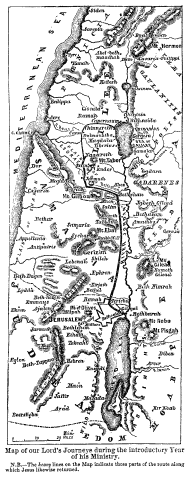
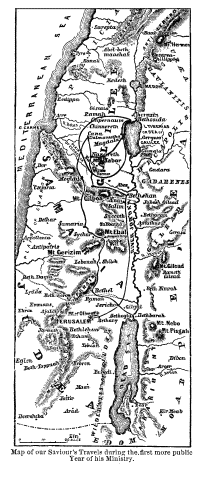
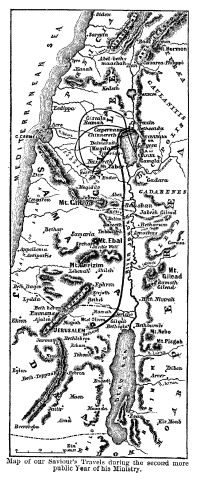
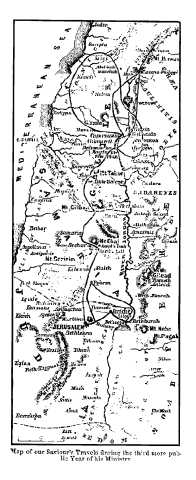
He then continued his expostulations with his captious hearers respecting his own character, until at length, on his avowing his divine preexistence, they attempted to stone him as guilty of blasphemy, but he withdrew from their midst (John 8:12-59). The seventy messengers returning shortly afterwards (prob. Oct. A.D. 28) with a report of great success, Jesus expressed his exultation in thanks to God for the humble instrumentality divinely chosen for the propagation of the Gospel (Luke 10:17-21, and parallel). Being asked by a Jewish sectary the most certain method of securing heaven, he referred him to the duty, expressed in the law (Deuteronomy 6:5; Leviticus 19:8), of supreme love to God and cordial philanthropy, and, in answer to the other’s question respecting the extent of the latter obligation, he illustrated it by the parable of the benevolent Samaritan (Luke 10:25-37). Returning at evening to the home of Lazarus, he gently reproved the impatient zeal of the kind Martha in preparing for him a meal, and defended Mary for being absorbed in his instructions (Luke 10:38-42). After a season of private prayer (prob. in Gethsemane, on his way to Jerusalem, next morning), he dictated a model of prayer to his disciples at their request, stating the indispensableness of a placable spirit towards others in order to our own forgiveness by God, and adding the parable of the guest at midnight to enforce the necessity of urgency in prayer, with assurances that God is more willing to grant his children’s petitions for spiritual blessings than earthly parents are to supply their children’s temporal wants (Luke 11:1-13, and parallels). As he entered the city, Jesus noticed a man whom he ascertained to have been blind from his birth, and to the disciples’ inquiry for whose sin the blindness was a punishment, he answered that it was providentially designed for the divine glory, namely, in his cure, as a means to which he moistened a little clay with spittle, touched the man’s eyes with it, and directed him to wash them in the Pool of Siloam (Saturday, Nov. 28, A.D. 28); but the hierarchy, learning the cure from the neighbors brought the man before them, because the transaction had taken place on the Sabbath, and disputed the fact until testified to by his parents, and then alleging that the author of the act, whose name was yet unknown even to the man himself, must have been a sinner, because a violator of the sacred day, they were met with so spirited a defense of Jesus by the man himself, that, becoming enraged, they immediately excommunicated him. Jesus, however, meeting him shortly after, disclosed to his ready faith his own Messianic character, and then discoursed to his captious enemies concerning the immunities of true believers in him under the simile of a fold of sheep (John 9; 10:1-21). The same figure he again took up at the ensuing Festival of Dedication, upon the inquiry of the Jewish sectaries directly put to him in Solomon’s portico of the Temple, as to his Messiahship, and spoke so pointedly of his unity with God that his auditors would have stoned him for blasphemy had he not hastily withdrawn from the place (cir. Dec. 1, A.D. 28), and retired to the Jordan, where he gained many adherents (John 10:22-42). Lazarus at this time falling sick, his sisters sent to Jesus, desiring his presence at Bethany; but after waiting several days, until Lazarus was dead, he informed his disciples of the fact (which he assured them would turn out to the divine glory), and proposed to go thither. On their arrival, he was met first by Martha and then by Mary, with tearful expressions of regret for his absence, which he checked by assurances (not clearly apprehended by them) of their brother’s restoration to life; then causing the tomb to be opened (after overruling Martha’s objection), he summoned the dead Lazarus forth to life, to the amazement of the spectators (John 11:1-46; probably Jan. A.D. 29). SEE LAZARUS. This miracle aroused afresh the enmity of the Sanhedrim, who, after consultation, at the haughty advice of Caiaphas, determined to accomplish his death, thus unwittingly fulfilling the destined purpose of his mission (John 11:47-53). Withdrawing in consequence to the city of Ephron (John 11:54), and afterwards to Perea, Jesus continued his teaching and miracles to crowds that gathered about him (Mark 10:1, and parallel). As he was preaching in one of the synagogues of this vicinity one Sabbath, he cured a woman of chronic paralysis of the back, and refuted the churlish cavil of one of the hierarchy present at the day on which this was done, by a reference to ordinary acts of mercy even to animals on the Sabbath (Luke 13:10-17; prob. Feb. A.D. 29). Jesus now turned his steps towards Jerusalem, teaching on the way the necessity of a personal preparation for heaven, without trusting to any external recommendations (Luke 13:22-30); and replying to the Pharisees’ insidious warning of danger from Herod, that Jerusalem alone was to a destined place of peril for him (Luke 13:31-33). On one Sabbath, while eating at the house of an eminent Pharisee, he cured a man of the dropsy, and silenced all objections by again appealing to the usual care of domestic animals on that day; he then took occasion, from the anxiety of the guests to secure the chief places of honor at the table, to discourse to the company on the advantages of modesty and charity, closing by an admonition to prompt compliance with the offers of the Gospel in the parable of the marriage feast and the wedding garment (Luke 14:1-15; Matthew 22:1-14, anti parallel; prob. March, A.D. 29). To the multitudes attending him he prescribed resolute self denial as essential to true discipleship (Luke 15:25, 26, and parallel), under various figures (Luke 14:28-33) ; while he corrected the jealousy of the Jewish sectaries at his intercourse with the lower classes (Luke 15:1, 2), by teaching the divine interest in penitent wanderers from him (Luke 19:10, and parallel), under the parables of stray sheep (Luke 15:3-7, and parallel), the lost piece of money, and the prodigal son (Luke 15:8- 32). At the same time, he illustrated the prudence of securing the divine favor by a prudent use of the blessings of this life in the parable of the fraudulent steward (Luke 16:1-12), showing the incompatibility of worldliness with devotion (Luke 16:13, and parallel); and the self sufficiency of the Pharisees he rebuked in the parable of the rich man and Lazarus (Luke 16:14, 15, 19-31), declaring to them that the kingdom of the Messiah had already come unobserved (Luke 17:20, 21). He impressed upon both classes of his hearers the importance of perseverance, and yet humility, in prayer, by the parables of the importunate widow before the unjust judge, and the penitent publican in contrast with the self- righteous Pharisee (Luke 18:1-14). To the insidious questions of the Jewish sectaries concerning divorce, he replied that it was inconsistent with the original design of marriage, being only suffered by Moses (with restrictions) on account of the inveterate customs of the nation, but really justifiable only in cases of adultery; but at the same time explained privately to the disciples that the opposite extreme of celibacy was to be voluntary only (Matthew 19:3-12, and parallels). He welcomed infants to his arms and blessing, as being a symbol of the innocence as required by the Gospel (Mark 10:13-16, and parallels). A rich and honorable young man visiting him with questions concerning the way of salvation, Jesus was pleased with his frankness, but proposed terms so humbling to his worldly attachments that he retired with, out accepting them, which furnished Jesus an opportunity of discoursing to his followers on the prejudicial influence of wealth on piety, and (in reply to a remark of Peter) of illustrating the rewards of self-denying exertion in religious duty by the parables of the servant at meals after a day’s work, and the laborers in the vineyard (Mark 10:17-29; Matthew 19:28, 29; Luke 17:710; Matthew 20:1-16; and parallels). As they had now arrived at the Jordan opposite Jerusalem, Jesus once more warned the timid disciples of the fate awaiting him there (Mark 10:32-34); but they so little understood him (Luke 17:34), that the mother of James and John ambitiously requested of him a prominent post for her sons under his administration, they also ignorantly professing their willingness to share his sufferings, until Jesus checked rivalry between them and their fellow disciples by enjoining upon them all a mutual deference in imitation of his self-sacrificing mission (Matthew 20:20-28). As they were passing through Jericho, two blind men implored of him to restore their sight, and, although rebuked by the by-standers, they urged their request so importunately as at length to gain the ear of Jesus, who called them, and with a touch enabled them to see (Mark 10:46-52, and parallels). Passing along, he observed a chief publican, named Zacchaeus (q.v.), who had run in advance and climbed a tree to get a sight of Jesus, but who now, at Jesus’ suggestion, gladly received him to his house, and there vindicated himself from the calumnies of the insidious hierarchy by devoting one half his property to charity, an act that secured his commendation by Jesus (Luke 19:2-9), who took occasion to illustrate the duty of fidelity in improving religious privileges by the parable of the “talents” or “pounds” (Luke 19:11-28, and parallel). Reaching Bethany a week before the Passover, when the Sanhedrim were planning to seize him, Jesus was entertained at the house of Lazarus, and vindicated Mary’s act in anointing (q.v.) his head with a flask of precious ointment, from the parsimonious objections of Judas, declaring that it should ever be to her praise as highly significant in view of his approaching burial (John 11:55-57; 12:1-11; and parallels).
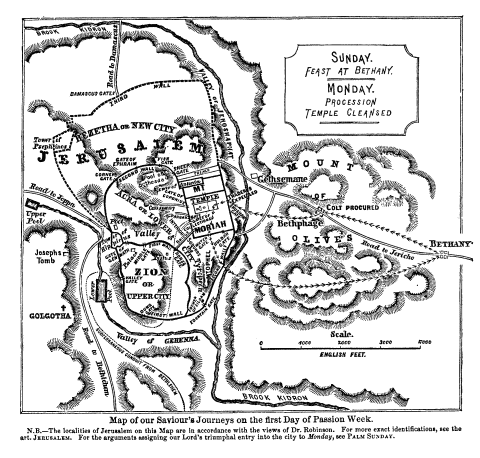
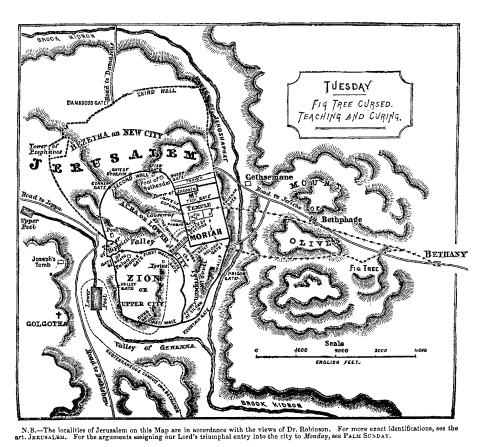
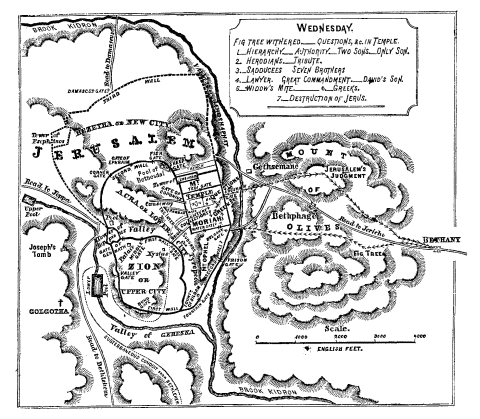
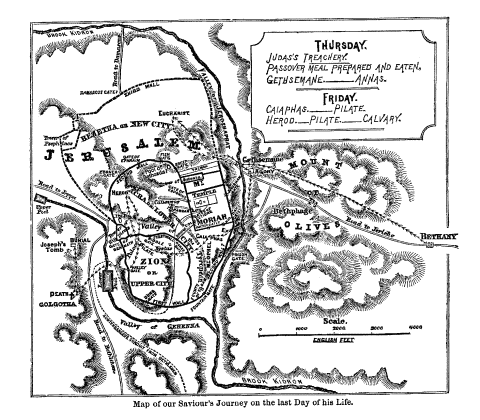
The same day Jesus sent two of his disciples into the city, with directions where to prepare the Passover meal (Luke 22:7-13), and at evening, repairing thither to partake of it with the whole number of his apostles, SEE LORDS SUPPER, he affectionately reminded them of the interest gathering about this last repast with them; then, while it was progressing, he washed their feet to reprove their mutual rivalry and enforce condescension to one another by his own example, SEE WASHING THE FEET, and immediately declared his own betrayal by one of their number, fixing the individual (by a sign recognized by him alone) among the amazed disciples (Luke 22:14-17, 24; John 13:1-15; Luke 22:25-30; John 13:17-19, 21, 22; Matthew 26:22-24; John 13:23-26; Matthew 26:25; and parallels). Judas immediately withdrew, full of resentment, but without the rest suspecting his purpose; relieved of his presence, Jesus now began to speak of his approaching fate, when he was interrupted by the surprised inquiries of his disciples, who produced their weapons as ready for his defense, while Peter stoutly maintained his steadfastness, although warned of his speedy defection (John 13:27-33, 36-38; Matthew 26:31-33; Luke 22:31-38; and parallels); then, closing the meal by instituting the Eucharist (q.v.) (Matthew 26:26-29, and parallels), Jesus lingered to discourse at length to his disciples (whose questions showed how little they comprehended him) on his departure at hand, and the gift (in consequence) of the Holy Spirit, with exhortations to religious activity and mutual love, and, after a prayer for the divine safeguard upon them (John 14:1-15, 17; 13:34, 35; 15:18-17, 26), he retired with them to the Mount of Olives (John 18:1, and parallels). Here, entering the garden of Gethsemane, he withdrew, with three of the disciples, a short distance from the rest, and, while they fell asleep, he three times prayed, in an agony (q.v.) that forced blood-tinged sweat from the pores of his forehead, for relief from the horror-stricken anguish of his soul, SEE BLOODY SWEAT, and was partially relieved by an angelic message; but Judas, soon appearing with a force of Temple guards and others whom he conducted to this frequent place of his Master’s retirement, indicated him to them by a kiss (q.v.); Jesus then presented himself to them with such a majestic mien as to cause them to fall back in dismay, but while Peter sought to defend him by striking off with his sword the ear of one of the assailants (which Jesus immediately cured with a touch, at the same time rebuking his disciple’s impetuosity), Jesus, after a short remonstrance upon the tumultuous and furtive manner of his pursuers’ approach, and a stipulation for his disciples’ security, suffered himself to be taken prisoner, with scarcely one of his friends remaining to protect him (Matthew 26:36-50; John 18:4-9; Luke 22:49; Matthew 26:51-56; Mark 14:51, 52; and parallels). SEE BETRAYAL. He was first led away to the palace of the ex-pontiff Annas, who, after vainly endeavoring to extract from him some confession respecting himself or his disciples (while Peter, who, with John, had followed after, three times denied any connection with him, SEE PETER, when questioned by the various servants in the courtyard, but was brought to pungent penitence by a look from his Master within the house), sent him for further examination to the acting high priest Caiaphas (John 18:13- 16, 18, 17, 25, 19-23, 26, 27; Luke 22:61, 62; John 23:24; and parallels). This functionary, assembling the Sanhedrim at daylight (Friday, March 18, A.D. 29), at length, with great difficulty, procured two witnesses who testified to Jesus’ threat of destroying the Temple (see John 2:19), but with such discrepancy between themselves that Caiaphas broke the silence of Jesus by adjuring him respecting his Messianic claims, and on his avowal of his character made use of his admission to charge him with blasphemy, to which the Sanhedrim present assented with a sentence of death; the officers who held Jesus thereupon indulged in the vilest insults upon his person (Matthew 26:57, 59-63; Luke 22:67-71, 63-65; and parallels). SEE CAIAPHAS. After a formal vote of the full Sanhedrim (q.v.) early in the forenoon, Jesus was next led to the procurator Pilate’s mansion for his legal sanction upon the determination of the religious court, where the hierarchy sought to overcome his reluctance to involve himself in the matter (which was increased by his examination of Jesus himself, who simply replied to their allegations by giving Pilate to understand that his claims did not relate to temporal things) by charging him with sedition, especially in Galilee, an intimation that Pilate seized upon to remand the whole trial to Herod (who chanced to be in Jerusalem at the time), as the civil head of that province (John 18:28-38; Matthew 27:12-14; Luke 23:4-7). Herod, however, on eagerly questioning Jesus, in hopes of witnessing some display of his miraculous power, was so enraged at his absolute silence that he sent him back to Pilate in a mock attire of royalty (Luke 23:8-12). The procurator, thus compelled to exercise jurisdiction over the case, convinced of the prisoner’s innocence (especially after a message from his wife to that effect), proposed to the populace to release him as the malefactor which custom required him to set at liberty on the holiday of the Passover (q.v.); but the hierarchy insisted on the release of a notorious criminal, Barabbas, instead, and enforced their clamor for the crucifixion of Jesus with so keen an insinuation of Pilate’s disloyalty to the emperor, that, after varied efforts to exonerate himself and discharge the prisoner (whose personal bearing enhanced his idea of his character), he at length yielded to their demands, and, after allowing Jesus to be beaten, SEE FLAGELLATION and otherwise shamefully handled by the soldiers, SEE MOCKING, he pronounced sentence for his execution on the cross (Luke 23:13-16; Matthew 15:17-19, 16, 20-30; John 19:4-16; and parallels). SEE PILATE. The traitor Judas, perceiving the enormity of his crime, now that, in consequence of his Master’s acquiescence, there appeared no chance of his escape, returned to the hierarchy with the bribe, which, on their cool reply of indifference to his retraction, he flung down in the Temple, and went and hung himself in despairing remorse (Matthew 27:3-10). SEE JUDAS. On his way out of the city to Golgotha, where he was to be crucified, Jesus fainted under the burden of his cross, which was therefore laid upon the shoulders of one Simon, who chanced to pass at the time, and as they proceeded Jesus bade the disconsolate Jewish females attending him to weep rather for themselves and their nation than for him; on reaching the place of execution, SEE GOLGOTHA, after refusing the usual narcotic, he was suspended on the cross between two malefactors, while praying for his murderers; and a brief statement of his offence (which the Jews in vain endeavored to induce Pilate to change as to phraseology) was placed above his head, the executioners meanwhile having divided his garments among themselves: while hanging thus, Jesus was reviled by the spectators, by the soldiers, and even by one of his fellow sufferers (whom the other penitently rebuking, was assured by Jesus of speedy salvation for himself, SEE THIEF ON THE CROSS ), and committed his mother to the care of John; then, at the close of the three hours’ preternatural darkness SEE ECLIPSE, giving utterance (in the language of Psalm 22) to his agonized emotions, SEE SABACTHANI amid the scoffs of his enemies, he called for something to quench his thirst. which being given him, he expired with the words of resignation to God upon his lips, while an earthquake (q.v.) and the revivification of the sleeping dead bore witness to his sacred character, as the by standers, SEE CENTURION were forced to acknowledge (Matthew 27:31, 32; Luke 23:27-31; Mark 15:22, 23, 25, 27, 28; Luke 23:34; John 19: 19-24; Matthew 27:36, 39-43; Luke 23:36, 37, 39. 43; John 19:25-27; Matthew 27:45-47, 49; John 19:28-30; Luke 23:46; Matthew 27:51-53; Luke 23:47, 48; and parallels). SEE PASSION. Towards evening, on account of the approaching. Sabbath, the Jews petitioned Pilate to cause the crucified persons to be killed by the usual process of hastening their death, SEE CRUCIFIXION, and their bodies removed from so public a place; and as the soldiers were executing this order, they were surprised to find Jesus already dead; one of the soldiers, however, tested the body by plunging a spear into the side, when water mixed with clots of blood issued from the wound (John 19:31-37). SEE BLOOD AND WATER. A rich Arimathaean, named Joseph (q.v.), a secret believer in Jesus, soon came and desired the body of Jesus for burial. and Pilate, as soon as he had ascertained the actual death of Jesus, gave him permission; accordingly, with the help of Nicodemus, he laid it in his own new vault, temporarily wrapped in spices, while the female friends of Jesus observed the place of its sepulture (Mark 15:42-44; John 19:38-42; Luke 23:25, 26; and parallels). SEE SEPULCHRE. Next day (Saturday, March 19, A.D. 29) the hierarchy, remembering Jesus’ predictions of his own resurrection, persuaded Pilate to secure the entrance to the tomb by a large stone, a seal, and a guard, SEE WATCH, at the door (Matthew 27:62-66). The women, meanwhile, prepared additional embalming materials in the evening for the body of Jesus (Mark 16:1). SEE EMBALM.
Very early next morning (Sunday, March 20, A.D. 29) Jesus arose alive from the tomb, SEE RESURRECTION, which an angel opened, the guards swooning away at the sight (Matthew 28:2-4, and parallel). The women soon appeared on the spot with the spices for completing the embalming, but, discovering the stone removed from the door, Mary Magdalene hastily returned to tell Peter, while the rest, entering, missed the body, but saw two angels at the entrance, who informed them of the resurrection of their Master, and. as they were returning to inform the disciples, they met Jesus himself; but the disciples, on their return, disbelieved their report (Mark 21:2-4; John 20:2; Luke 24:3-8; Matthew 28:7-10; Luke 24:9, 10; and parallels). The guard, however, had by this time recovered, and, on reporting to the hierarchy, they were bribed to circulate a story of the abreption of the body during their sleep (Matthew 33:11-15). Mary Magdalene meanwhile had roused Peter and John with the tidings of the absence of the body, and, on their hastening to the tomb, they both observed the state of things there, without arriving at any satisfactory explanation of it); but Mary, who arrived soon after they had left, as she stood weeping, saw a person of whom, mistaking him for the keeper of the garden, she inquired for the body, but was soon made aware by his voice that it was Jesus himself, when she fell at his feet, being forbidden a nearer approach, but bidden to announce his resurrection to the disciples (John 20:11-18; Mark 16:11; and parallels). On the same day Jesus appeared to two of the disciples who were going to Emmaus, and discoursed to them respecting the Christology of the Old Test., but they did not recognize him till they were partaking the meal to which, at their journey’s end, they invited him, and then they immediately returned with the news to Jerusalem, where they found that he had in the meanwhile appeared also to Peter (Luke 24:13-33, and parallels). At this moment Jesus himself appeared in their midst, and overcame their incredulity by showing them his wounds and eating before them, and then gave them instructions respecting their apostolical mission (Luke 24:36-49; John 20:21; Mark 16:15-18; John 10:4, 22, 23; and parallels). Thomas, who had been absent from this interview, and therefore refused to believe his associates’ report, was also convinced, at the next appearance of Jesus a week afterwards (Sunday evening, March 27, A.D. 29), by handling him personally (John 20:24-29). Some time afterwards (prob. Wednesday, March 30, A.D. 29) Jesus again appeared to his disciples on the shore of the Sea of Tiberias, as they were fishing; and, after they had taken a preternatural quantity of fish at his direction, coming ashore, they partook of a meal which he had prepared, after which he tenderly reproved Peter for his unfaithfulness, and intimated to him his future martyrdom (Matthew 28:16; John 21:1-23). Soon afterwards (probably Thursday. March 31, A.D. 29) he appeared to some five hundred of his disciples (1 Corinthians 15:6) at an appointed meeting on a mountain in Galilee, where he commissioned his apostles afresh to their work (Matthew 28:16-20). Next he appeared to James (1 Corinthians 15:7), and finally to all the apostles together, SEE APPEARANCE (OF RISEN CHRIST), to whom, at the end of forty days from his passion (Thursday, April 28, A.D. 29), he now gave a general charge relative to their mission, SEE APOSTLE, and, leading them towards Bethany, while blessing them he was suddenly carried up bodily into the sky, SEE ASCENSION and enfolded from their sight in a cloud, SEE INTERCESSION; angels at the same time appearing and declaring to them, in their astonishment, his future return in a similar manner (Acts 1:2-12, and parallels): (For a fuller explanation of the details of the foregoing narrative, see Strong’s Harmony and Exposition of the Gospels, N.Y., 1852.) SEE GOSPELS.
The more modern theology (we refer here mainly to German theology since Schleiermacher) attempted to crowd forward the ideal. Thus Hase proposed for his task the treatment “how Jesus of Nazareth, according to divine predestination, by the free exercise of his own mind, and by the will of his age, had become the Savior of the world.”
A still more destructive attitude (comp. Lange, 1, 10 sq.) was assumed by Strauss, who, while not denying that Jesus had lived, yet recognized in the accounts of the gospels simply a mythical reflex of what the young Christian society had invented to connect with the prophetical announcements of the old covenant, though, of course, he added that it had been done unconsciously and thoughtlessly. Thus the (poetico-speculative) truth of the ideal Christ was to be maintained, but it soon vanished in the clouds like a mist. In a modified form this mythical theory was advocated by Weisse, who, like others before him, endeavored to solve the miraculous in .the life of Christ by the introduction of higher biology (magnetism, etc.), and used Strauss’s hypotheses in order to dispose of whatever he found impracticable in his own view. The Tübingen theologian, Bruno Bauer (Kritik. der evangel. Gesch. vol. 3), went further, and declaring that he could not see in the accounts of the apostles a harmless poesy, branded them as downright imposture. A much more moderate position was taken by one who utterly disbelieved the fulfilment of the prophecies, Salvador the Jew. He acknowledged the historical personality of Jesus, though the Savior, in his treatment, came to be nothing but a Jewish reformer (and, of course, a demagogue also).
It must be acknowledged, however, that these criticisms provoked a more thorough study of the subject, and that orthodox Christianity is therefore in no small measure indebted to German rationalism for the great interest which has since been manifested in the history of our Lord. The rationalistic works called forth innumerable critiques and rejoinders (most prominent among: which were those of W. Hoffman, Stuttg. 1838 sq.; Hengstenberg. in the Evangel. Kirchenzeitung, 1836; Schweizer, in the Stud. u. Krit. 1837, No. 3; Tholuck,. Hamburg, 1838; Ullmann, Hamb. 1838); and finally resulted in the publication of a vast number of protections on the life of Jesus.
We call attention, likewise, to the efforts of the Dutch theologians, among whom are Meijboom (Groning. I861), Van Osterzee, and others. A new treatment of the-subject was promised by the late chevalier Bunsen (Preface to his Hippolytus, p. 49) but it never made its appearance. Ewald, however, continued his work on the Jews (Gesch. d. Volkes Israel), closing in a fifth volume with the life of Christ (Lebenz Christus). The author evidently is a non-believer in our Lord’s godhead (compare Liddon, Bampt. Lecture, 1866, p. 505). His method of dealing with the subject has something of the same indefiniteness which characterized the work of Schleiermacher (compare Plumptre, Boyle Lecture, 1866; p. 336). Ewald views Jesus “as the fulfilment of the O.T. as the final, highest, fullest, clearest revelation of God — as the true Messiah, who satisfies all right longing for God and for deliverance from the curse-as the eternal King of the kingdom of God. But with all: this, and while he depicts our Lord’s person and work in its love, activity, and majesty, with a beauty that is not often met with, there is but one nature accorded to this perfect Person, and that nature is human.” Of a very different character from all these works are the lectures of Prof. C. J. Riggenbach, of Basle, who presents us the picture of our Lord from a harmonistico-apologetic point of view.
Here deserve mention also the labors of Neander, who, “in the conviction, which runs through his Church History, that Christendom rests upon the personality of Christ,” was not a little alarmed by the production of Strauss, and “with fear and trembling, feeling that controversy was a duty, and yet also that it marred the devotion of spirit in which alone the life of his Lord and Master could be contemplated rightly,” entered the lists against rationalistic combatants. His excellent work has found a worthy translator in the late Rev. Dr. M’Clintock. We pass over men like Hare, “who reproduce more or less the rationalism of Paulus” (perhaps the first conspicuous work of the rationalistic Germans, though it failed to awaken the general interest that Strauss’s work did; comp. Plumptre, Boyle Lect. 1866, p. 329); others also, who, like Ebrard and Lange, “avowedly assume the position of apologists, though their works are at least evidence (as are bishop Ellicott’s Hulsean Lect., and the many elaborate commentaries on the Gospels in our country and abroad) that orthodox theologians do not shrink from the field of inquiry thus opened.”
A time of quiet and rest seemed now to have dawned upon this polemical field of Christian theology, when suddenly, in 1863, the learned Frenchman Renan appeared with his Vie de Jesus, and stirred anew the spirits, as Strauss had done thirty years before. Most arbitrarily did Mr. Renan deal with the data upon which his work professed to be based; while theologically he proceeded throughout “on a really atheistic assumption, disguised beneath the veil of a pantheistic phraseology ... It is, however, when we look at the Vie de Jesus from a moral point of view that its shortcomings are most apparent in their length and breadth. Its hero is a fanatical impostor, who pretends to be and to do that which he knows to be beyond him, but who, nevertheless, is held up to our admiration as the ideal of humanity” (Liddon, p. 506). It is sufficient to reply to this caricature by Mr. Renan that, “If this be the founder of Christianity, and if Christianity be the right belief, then all religion must cease from the earth; for not only is this character unfit to sustain Christianity, but it is unfit to sustain any religion; it wants the bond” (Lange, 1, 18). Yet “it may be that to the thousands whose thoughts have either rested in the symbols of the infancy and the death which the cultures of the Latin Church brings so prominently before them, or who, having rejected these, have accepted nothing in their place, the Vie de Jesus has given a sense of human reality to the Gospel history which they never knew before, and led them to study it with a more devout sympathy” (Plumptre, p. 337). Countless editions and translations were made of the work, and it was read everywhere with as much interest as if it had been simply a work of fiction; indeed German theologians, even the Rationalists, hesitated not to rank it among French novels. Innumerable are the works which were written against and in defense of this legendary hypothesis. In Germany, especially, the contest raged fiercely, and for a time it seemed as if the materialistic Frenchman was to uproot all Christian feelings in the hearts of the common people of Germany when Strauss suddenly reappeared on the stage in behalf of his mythical theory with a new edition of his Leben Jesu, this time prepared for the wants of the German people, “and the new work, more popular in form, more caustic and sneering in its hostility, has been read as widely as the old. Mustering all old objections and starting anew, he seeks to prove that the first three gospels contradict each other and the forth. Without entering into the more elaborate theories as to their origin and their relation to the several parties and sects in early Christendom, as Baur did afterwards, he has a general theory which accounts for them. Men’s hopes and wishes, their reverence and awe, tend at all times to develop themselves into myths ... The myths were not ‘cunningly devised,’ but were the spontaneous, unconscious growth of the time in which they first appeared. If men asked what, then, was left them to believe in what was the idea which had thus developed itself through what had been worked on as the facts of Christianity, the answer was that God manifested himself, not in Christ, but in humanity at large humanity is the union of the two natures, the finite and the infinite, the child of the visible mother and the invisible father ... The outcry against the book was, as might be expected, enormous. It opened the eyes of those who had dallied with unbelief to see that they were naked, and it stripped off the fig leaf covering of words and phrases with which they had sought to hide their nakedness. What was offered as the compensation for all this work of destruction; if it were offered in any other spirit than that of the mockery even then, and yet more now, so characteristic of the author, was hardly enough to give warmth and shelter to any human soul” (Plumptre, p. 334). The ablest among Christian divines and scholars came forward to refute, the naked falsehoods, and up to our day the contest rages, nor can it be said how soon it will be ended; it is certain, however, that orthodox Christianity is daily gaining ground, even in the very core of the heart of Rationalism. In France it drew forth the able work of Pressense, Jesus Christ son Temps, sa Vie son (OEuvre (Paris, 1865), which has since appeared in an English dress in this country. In England, Ecce Homo, a survey of the life and work of Jesus Christ (London, 1866), was a response to French and German Rationalists, in so far as the reality of our Savior’s human career is concerned. (See above, 2, 3.)
Great service has also been done for the truth by the productions of Weiss (Sechs Vortrage über die Person Jesut Christi, Ingolst. 1864), Liddon (Bampton Lecture, 1866; see Christiac Remembrancer, Jan. 1868, article 6), and particularly by Row (London, 1868; N.Y. 1871; see Princeton Rev. 1810, art. 5), Plumptre’ (Boyle Lect. 1866), R. Payne Smith (Bampton Lecture, 1869), Leathes, Witness of St. John to Christ (Boyle Lect. 1870), Andrews, and Hanna. Several popular treatises on the subject were also produced in Germany, England, and America, among which are those of Abbott and Eddy. Henry Ward Beecher has just published vol. 1 of a similar work.
(1.) Of a general character are treatises by the following authors, respecting the proper method of investigating the career of Christ: Doderlein (Jena, 1783 sq.), Semler (Hal. 1786), Eberhard (Hal. 1787), Albers (Gbtt. 1793), Ammon (Gitt. 1794), Bruggeman (Gott. 1795), Stuckert (Francfort, 1797), Muller (Stuttg. 1785), Piper (Gott. 1835), Sextroth (Gott. 1785), Peterson (Lub. 1838), Scholten (Traj. 1840), Wiggers (Rost. 1837). On profane and apocryphal materials: Kocher (Jena, 1726), Meyer (Hamb. 1805), Augusti (Jena, 1799), Huldric (L.B. 1705), Werner (Stad. 1781). Diatessura of the Gospel history have been composed by the following: J.F. Bahrdt (Lpz. 1772), Roos (Tübingen, 1776), Mutschelle (Munch. 1784), C.F. Bahrdt (Berl. 1787), Bergen (Giessen, 1789 sq.),White (Oxon. 1800), Keller (Stuttg. 1802). Hom (Nurnburg, 1803), Sebastiani (Lpzg. 1806), Muller (Wien, 1807), Langsdorf (Mannheim, 1830), Kuchler (Lips. 1835), and others. SEE HARMONIES.
Discussions on the life of Jesus, in a more historical form; of a hostile character, are by the following: Reimar (Braunschweig, 1778 sq.), C.F. Bahrdt (Halle, 1782; Berl. 1784 sq.), J. G. Schulthess (Zur. 1783),Venturini (Kopen. 1800), Langsdorf (Mannh. 1831), D. F. Strauss (Tibing. 1835, 1837, 1838 [the work which provoked the innumerable critiques and rejoinders, as above stated], Sack (Bonn, 1836), Theile (Lpzg. 1832), Hahn (Leipzig, 1839).
Of an apologetic character [besides those in express opposition to Strauss] are the following: Reinhard (Wittenburg, 1781; 5th edition, with additions by Heubner, 1830), Hess (Zurich, 1774, rewritten 1823), Vermehren (Halle, 1799), Opitz (Zerbst, 1812), Planck (Gott. 1818), Bodent [Rom. Cath.] (Gernund. 1818 sq.), Paulus (Heidell). 1828), J. Schulthess (Zurich, 1830), Hase (Lpzg. 1829, 1835), Neander (Hamb. 1837; translated M’Clintock and Blumenthal, N.Y. 1840), Kleuker (Brem. 1776; Ulm. 1793), Basedow (Lpz. 1784), Wizenman (Lpz. 1780), Herder (Riga, 1796), Hacker (Leipzig, 1801-3), Schorch (Lpzg. 1841), Kolthoff (Hafn. 1852), Hofmann (Leipzig, 1852), Keim (Zir. 1861, 1864), Wisenmann (1864), Weiss (Ingolst. 1864). SEE RATIONALISM.
Among those of a more practical character are the following: Walch (Jena, 1740), Huniber (Frankf. 1763), Hoppenstedt (Hannov. 1784 sq.), Hunter (Lond. 1785), Fleetwood (Lond.), Cramer (Lpz. 1787), Marx (Munster, 1789, 1830), Gosner (Leipzig, 1797; Zurich, 1818), Sintenis (Zerbst, 1800), Meister (Basel, 1802), Reichenberger (Wien, 1793, 1826), Gerhard and Muller (Erfurt, 1801), Bauriegel (Neustadt, 1801, 1821), Greiling (Halle, 1813), Jacobi (Gotha, 1817; Sonders. 1819), Pflaum (Nurnburg, 1819), Ammon (Lpzg. 1842-7, 3 vols.), Muller (Berlin, 1819, 1821), Schmidt (Wien, 1822, 1826), Francke (Bresl. 1823, Lpzg. 1838, 1842), Buchfelner (Münch. 1826), Neavels (Aachen, 1826), Stephani (Magdeb. 1830), Onymus (Sulzb. 1831), Blunt (London, 1835), Hartmann (Stuttg. 1837), Weisse (Lpzg. 1838), Kuhn (Mainz, 1838), Lehrreich (Quedl. 1840), Hirscher (Tubing. 1839), Wurkerts (Meiss. 1840), Hug (1840), Krane (Cass. 1850), Lichtenstein (Erl. 1855), Rougemont (Paris and Lausanne, 1856), J. Bucher (Stuttgard, 1859), Krummacher (Bielf. 1854), Baumgarten (Brunsw. 1859), Uhlhorn (Hamb. 1866; Bost. 1868), Ellicott (London, 1859), Andrews (N.Y. 1862).
Among those pictorially illustrated are the works of Schleich (Munch. 1821), Langer (Stuttgart, 1823), Kitto (Loud. 1847), Abbott (N.Y. 1864), Crosby (N.Y. 1871).
Among those of a poetical character are Juvencus, ed. Arevalus (Rom. 1792),Vida (L.B. 1566, ed. Muller; Hamb. 1811), Wilmsen (Berlin, 1816, 1826), Gittermann (Hannov. 1821), Schincke (Hal. 1826), Klopstock (Hal. 1751, and often), Lavater (Winterth. 1783), Halem (Hannov. 1810), Weihe (Elberf. 1822, 1824), Wilmy (Sulzb. 1825), Kirsch (Lpz. 1825), Gopp (Lpz. 1827).
(2.) Of a more special nature are treatises on particular portions of Christ’s outward history or circumstances, e.g. his relatives: Walther (Berl. 1791), Oertel (Germ. 1792), Hasse (Regiom. 1792; Berl. 1794), Ludewig (Wolfenb. 1831). Tiliander (Upsal. 1772), Gever (Viteb. 1777), Blom (L. Bat. 1839), Oosterzee (Traj. a. R. 1840); and his country: Konigsman (Slesvic. 1807). Among those on his birth: Korb (Lpz. 1831), Meerheim (Viteb. 1785), Reimer (Lubec, 1653), Oetter (Numbers, 1774); and in a chronological point of view, among others: Masson (Roterd. 1700), Maius (Kilon. 1708; id. 1722), Reineccius (Hal. 1708), Liebknecht (Giess. 1735), Hager (Chemnit. 1743), Mann (Lond. 1752), Jost (Wirceb. 1754), Haiden (Prague, 1759), Reccared (Region. 1768; id. 1766), Horix (Mogunt. 1789), Sanclemente (Rome, 1795), Michaelis (Wien, 1797), Munter (Kopenh. 1827), Feldhoff (Frankf 1832), Mayer (Gryph. 1701), Hardt (Helmstadt, 1754), Korner (Lipsiae, 1778), Mynster (Kopenh. 1837), Huschke (Bresl. 1840), Caspari (Hamb. 1869); compare Stud. u. Krit. 1870, 2, 357; 1871, 2; Baptist Quarterly, 1871, p. 113 sq.; and see Zumpt, Das Geburtsjahr Christi (Leipzig, 1869). On his infancy, education, etc.: Niemeyer (Halle, 1790), Ammon (Gitting. 1798), Schubert (Gryph. 1813), Carpzov (Helmst. 1771), Weise (Helmst. 1798), Lange (Ald. 1699), Arnold (Regiom. 1730), Rau (Erl. 1796), Bandelin (Lub. 1809). On the duration of his ministry: Chrysander (Brunsw. 1750), Pisanski (Regiom. 1778), Loeber (Altenb. 1767), Korner (Lips. 1779), Priestley (Birmingham, 1780), Newcome (Dublin, 1780), Priess (Rost. 1789), Hinlein (Erlang. 1796). SEE APOSTLE. On his baptism, SEE JOHN THE BAPTIST. On his travels: Schmidt (Ilmenau, 1833; Paris, 1837). On his celibacy: Niedner (Schneeberg, 1815). On his teaching: Tschucke (Lipsiae, 1781), Bahrdt (Berlin, 1786), Manderbach (Elberf. 1813), Martini (Rost. 1794), Stier (Leipzig, 1853 sq.; Edinb. 1856 sq.). SEE SERMON ON THE MOUNT. On his alleged writings: Ittig (Lipsiae, 1696), Epistola apocrypha J.C. ad Petrum (Rom. 1774), Sartorius (Basil. 1817), Gieseke (Lunenb. 1822), Witting (Braunschw. 1823). SEE ABGAR On his miracles (q.v.): Heumann (Gott. 1747), Pfaff (Tübingen, 1752), Pauli (Riga, 1773), Trench (Lond. 1848; N.Y. 1850). On his transfiguration (q.v.): Reusmann (Getting. 1747), Georgi (Viteb. 1744), anonymous Essay (Lond. 1788), Haubold (Gott. 1791), Eger (1794), Rau (Erl. 1797); and his white garment, Franke (Lips. 1672), Sagittarius (Jena, 1673). On his temptation (q.v.): Baumgarten (Halle, 1755), De Saga (Gdtt. 1757), Farmer (London, 1671), Sauer (Bonn, 1789), Postius (Zweibr. 1791), Ziegenhagen (Franckfort, 1791), Domey (Upsal. 1792), Schutze (Hamb. 1793), Dahl (Upsal. 1800), Bertholdt (Erl. 1812), Gellerichts (Altenb. 1815), Richter (Viteb. 1825), Schweizer (Zurich, 1833), Ewald (Bayreuth, 1833); comp. the Zeitschr. f. wissensch. Theol. 1870, p. 188 sq. On his passion (q.v.): Iken (Brem. 1743 Tr. a. R. 1758), Baumgarten (Halle, 1757), Glanz (Stuttg. 1809), Henneberg (Lpzg. 1823), Schlegel (Lpzg. 1775), Mosche (Franckfort, 1785), Ewald (Lemgo, 1785), Fischer (Lpzg. 1794), Kindervater (Lpzg. 1797), Mosler (Eisenb. 1816), Krummacher (Berl. 1817), Jongh (Tr. a. R. 1827), Adriani (Tr. a. R. 1827),Walther (Bresl. 1738; Lpzg. 1777). On his crucifixion (q.v.): Schmidtman (Osnabr. 1830), Neubig (Erl. 1836), Hasert (Berl. 1839), Karig (Lpzg. 1842), Stroud (Lond. 1847). SEE AGONY; SEE ATONEMENT. On his words upon the cross: Hopner (Lips. 1641), Dankauer (Arg. 1641), Luger (Jena, 1739), Scharf (Viteb. 1677), Niemann (Jena, 1671), Lokerwitz (Viteb. 1680). On his burial: Te Water [i.e. Wesseling] (Traj. a. Rh. 1761). SEE CALVARY. On his resurrection (q.v.): among others, Buttstedt (Gerae, 1749), Sherlock (London, 1751), Seidel (Helmst. 1758), Weickhmann (Viteb. 1767), Burkitt (Meining. 1774), Rehkopf (Helmstadt, 1775), Lüderwald (Helmst. 1778). Less (Gott. 1779), Scheibel (Frankf. 1779), Mosche (Frankf. 1779), Semler (Halle, 1780), Moldenhauer (Hamb. 1779), Velthusen (Helmst. 1780), Pfeiffer (Erlang. 1779, 1787), Michaelis (Hal. 1783), Schmid (Jena, 1784), Plessing (Hal. 1788), Volkmar (Bresl. 1786), Henneberg (Lpzg. 1826), Frege (Hamb. 1833), Griesbach (Jena, 1784), Niemeyer (Hal. 1824), Rosenmüller (Erlang. 1780), Paulus (Jena, 1795), Pisansky. (Regiom. 1782), Zeibich (Gerae, 1784), Rusmeyer (Gryph. 1734), Feuerlein (Gott. 1752), Gutschmidt (Halle, 1753), Miller (Hafi. 1836). On his ascension (q.v.), among others: Griesbach (Jena, 1793), Seller (Erlang. 1798, 1803), Ammon (Gott. 1800), Otterbein (Duisb. 1802), Flügge (Argent. 1811),Weichert (Viteb. 1811), Fogtmann (Havn. 1826), Hamna, The Forty Days after our Lord’s Resurrection (London, 1863).
The following are some of the treatises on the personal traits of Jesus, e.g. his physical constitution: Weber (Hal. 1825), Engelmann (Lpz. 1834), Gieseler (Götting. 1837). On his dress: Zeibich (Witt. 1754), Gerberon (Par. 1677). His language: Reiske (Jena, 1670), Kleden (Viteb. 1739), Diodati (Neapol. 1767), Pfannkuche (in Eichhorn’s Allg. Bibl. 7, 365-480), Wiseman (in his Hor. Seyr. Rome, 1828), Zeibich (Viteb. 1791), Paulus (Jena, 1803). On his mode of life: Lunze (Lips. 1784), Rau (Erl. 1787, 1796), Jacobaeus (Hafn. 1703), Schreiber (Jena, 1743), Tragard (Gryph. 1781). On his intercourse with others: Gesenius (Helmstadt, 1734), Jetze (Liegn. 1792). Respecting the inner nature of his character, the following may be named, e.g. on his (human) disposition and temperament: Woytt (Jena, 1753), Bucking (Stendal. 1793), Schinmaier (Flensb. 1774 sq.), Winkler (Lpz. 1826), Dorner (Stuttg. 1839); on his psychology, see the Biblioth. Sacra, April, 1870. On his sinlessness, among others: Walther (Viteb. 1690), Baumgarten (Hal. 1740), Erbstein (Meiss. 1787), Weber (Viteb. 1796), Ewald (Hannov. 1798; Gerae, 1799), Ullmann (Hamburg, 1833, translated in Clark’s Biblical Cabinet, Edinburgh), Fritzsche (Halle, 1835). SEE MESSIAH.